







Seattle-based firms tout the benefits of PDB at a recent industry summit, which drew owners and A/E/C professionals who desire a better delivery method.
By Bradley Fullmer
The completion of the $526 million US-89 Farmington I-84 highway corridor in early 2024 marked the first official progressive design-build (PDB) project in Utah, spurred by the Utah Department of Transportation's willingness to push the project delivery envelope on a more collaborative design and construction process.
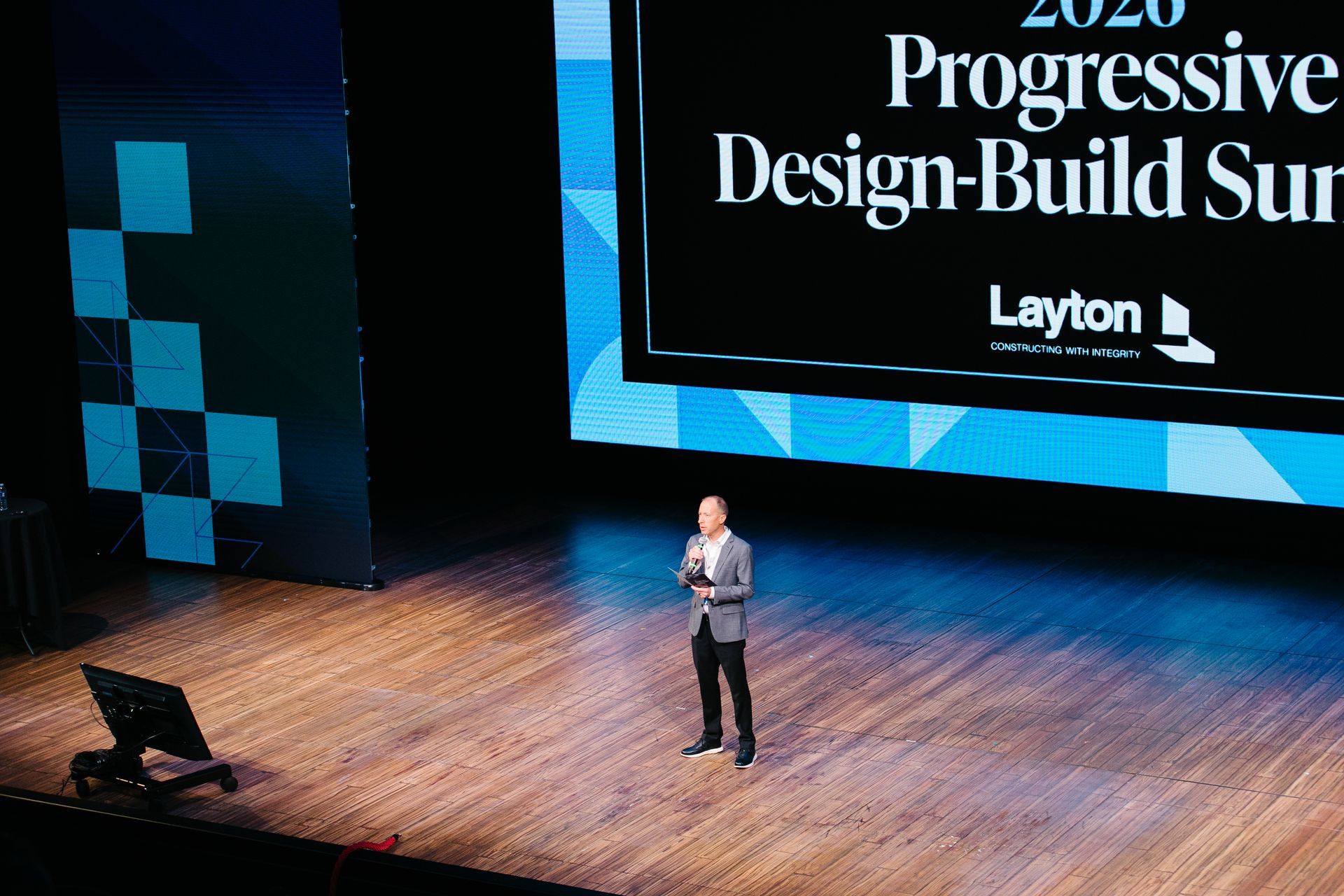
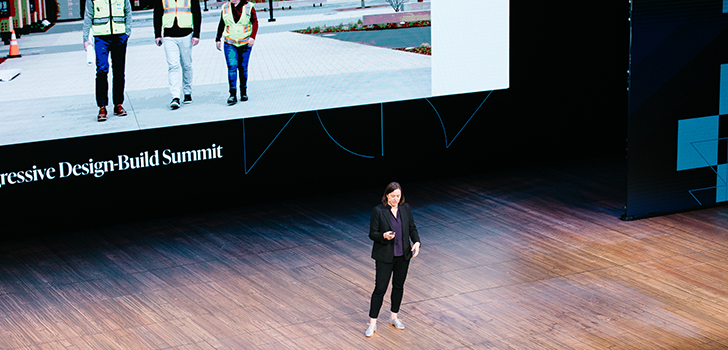
Regarding the vertical building market in the Beehive State, much work needs to done educating owners and A/E/C team members before PDB is fully utilized. At a PDB Summit April 14 at Hale Center Theatre in Sandy hosted by Sandy-based Layton Construction, executives from a trio of Seattle-based firms spoke to local industry professionals and said the delivery model tends to function best when owners stay engaged, project teams collaborate early, and trust in each other outweighs the need for parties to protect their own self-interests.
In a commercial building environment where construction teams are being asked to deliver more certainty and less risk, PDB is gaining momentum as a model built for complexity, speed, and shared problem-solving.
All featured speakers came from Seattle, including Troy Stedman, President and CEO of Seattle-based Abbott Construction; Mica Simpson, a Partner in the national construction practice at Seattle-based law firm Perkins Coie; and Todd Stine, a Partner with Seattle-based ZGF Architects. Even coming from the contractor, legal, and design sides of the table, each arrived at a strikingly consistent conclusion: progressive design-build works best when the right people are involved early, when owners understand their role, and when the process is allowed to be genuinely collaborative.
A Contractor’s Framing
For Stedman, the case for PDB is no longer theoretical. Abbott Construction, which operates along the West Coast, now performs a substantial portion of its work under the model—roughly one-third of the company’s Washington volume, and half of 2025 overall revenue, is typically delivered via PDB.
What the firm has learned, Stedman said, is that success in PDB has less to do with project type than with process discipline and team composition.
“Clients are often on a journey toward a better way to build, and they need a team that knows how to guide that process,” said Stedman.
That is why Abott Construction created an alternative delivery group focused specifically on these kinds of projects—a dedicated team across the construction scope who regularly work together and understand the unique demands of collaborative delivery.
His most memorable example was a hospital expansion in Port Townsend, Washington, for non-profit public agency Jefferson Healthcare. The project started with friction as the hospital’s CEO, shaped by a poor prior experience under a traditional design-bid-build model, entered the PDB process with deep skepticism. Decision-making was tightly centralized, workshop conversations were stilted, and the collaboration was not really happening.
“Clients are often on a journey toward
a better way to build, and they need a team
that knows how to guide that process.”
—Troy Stedman
Stedman said the turning point came when he met privately with the CEO and urged him to loosen his grip on the process, where senior leaders could be more guardrail than gatekeeper, empowering the working team to solve problems openly and honestly. Once that shift happened, the project team took off, finishing the job successfully on time and under budget.
By the ribbon-cutting, the same CEO had turned from skeptic to enthusiastically praising PDB as the right way to deliver public work.
For Stedman, that experience crystallized one of the model’s biggest truths: PDB is more than a contract structure, but a behavioral structure with an involved owner and high-trust team willing to quickly address and dispose of toxic dynamics.
Tools like project charters, risk registers, choosing-by-advantages decision-making, and a clear governance structure that separates the various scopes ranging form micro to macro. Done right, he said, those structures do more than solve problems; they create culture.
The Legal Perspective
As a lawyer who often represents owners, Simpson joked that being invited to speak at a contractor-hosted event was itself evidence that the PDB model is working. In a delivery method often described as collaborative, she argued that the contract must be built to support collaboration instead of undermining it.
What makes PDB unique, she said, is that parties agree to a contract before they have fully agreed on the ultimate business terms—cost, schedule, scope, and timing are intentionally deferred while the team develops the project together. That multi-phase structure gives owners flexibility, but it also demands clarity about process, roles, and risk allocation.
Simpson pointed to projects where that flexibility has proved especially valuable, including a hospital development in Idaho involving roughly 10 different legal owners with overlapping interests and scopes. In that setting, PDB allowed the broader team to begin conceptual work for the campus while preserving the ability for different parties to define and contract for their individual pieces over time.
While PDB allows for flexibility and an involving contract, discipline is still required. Simpson stressed the importance of risk planning from the outset and using the contract to reflect the realities of an evolving design process. PDB, she suggested, offers one of the industry’s best opportunities to align legal structure with actual project behavior.
Architectural Viewpoint
Stine added another layer to the discussion. ZGF, a 600-plus-employee firm with seven offices, has completed more than 143 design-build projects, including notable work in Utah for the Church of Jesus Christ of Latter-day Saints—the LDS Conference Center and City Creek Mall in downtown Salt Lake and projects at the Missionary Training Center in Provo.
He traced ZGF's design-build journey from high-risk federal pursuits after the Great Recession to more recent PDB work with public institutions in Washington. Across that spectrum, one lesson stands out: owners need a strong “North Star".
Teams perform best, said Stine, when the owner has done substantial internal work defining values, decision-making structures, and risk tolerance before the job gains momentum. An owners looking to incorporate PDB, he said, must understand how their organization makes decisions, who has authority, how flexible the culture is, and whether the owner is prepared to stay actively engaged as PDB is not a turnkey excuse for owners to step away. If anything, it requires more timely input, more transparency, and more availability from the owner side.
From the designer side, Stine said PDB's biggest advantage is early collaboration with contractors and trade partners. PDB creates more opportunity to test ideas, resolve scope questions, and tap subcontractor expertise early on while the design is still forming. That process can lead to better execution, better value and fewer downstream surprises.
But as with any project or delivery method, it comes down to trust and expertise. "If you have the wrong people sitting at the table,” Stine said, “it's going to be a challenging project, regardless of the delivery method. You need that willingness to engage in the project and be honest with each other about what works or doesn't work and why, and not be protective of your [individual] risk."

PDB's Future in Utah
The message from Utah’s first Progressive Design-Build Summit was clear: progressive design-build is not a silver bullet that will suddenly vanquish the industry’s many challenges, but it is a powerful framework when used as intended.
Matt Boyer, Deputy Director for the State of Utah's Division of Facilities Construction and Management (DFCM), also spoke about where the DFCM is with considering PDB on its future projects. Boyer said PDB "is a realistic delivery method for DFCM if the right stakeholder group and project can be identified" and that DFCM's leadership team is "cautiously optimistic that this could be a great delivery method from which projects could benefit."
While the methodology seems to offer valuable benefits for a project while bridging the gaps between design-build and CM/GC, Boyer said, “Having not gone through a progressive design-build project yet, some questions remain regarding value brought and costs incurred on the project."
Boyer said one current PDB solicitation is underway for Dixie Technical College’s Trades and Technology Building in St. George. Once DFCM gains some experience with the PDB approach, he continued, ”We may explore additional opportunities to utilize it on other projects."
Landon Sherwood, Director of Business Development for Layton, said the event was a "huge success" and “eye opening” for the over 100 industry professionals in attendance, one that will help PDB to become more prominent in the near future.
"I believe the future for PDB looks bright in Utah," said Sherwood. “The opportunity for collaboration and innovation is second to none in PDB.”