








As the youngest city in Utah, Millcreek has sought to create its own downtown and a newfound sense of civic pride. By Taylor Larsen
When a boat puts down an anchor, it aims to stay put.
In retail developments, anchors refer to tenants, and anchor tenants are the largest, most prominent stores. They lend an additional air of credibility to many of the smaller surrounding stores as they generate the foot traffic needed for business.
Millcreek, Utah’s newest city, created an anchor location for an emerging downtown. The official aim was to draw residents, developers, and businesses into the city, and the execution is Millcreek Common.
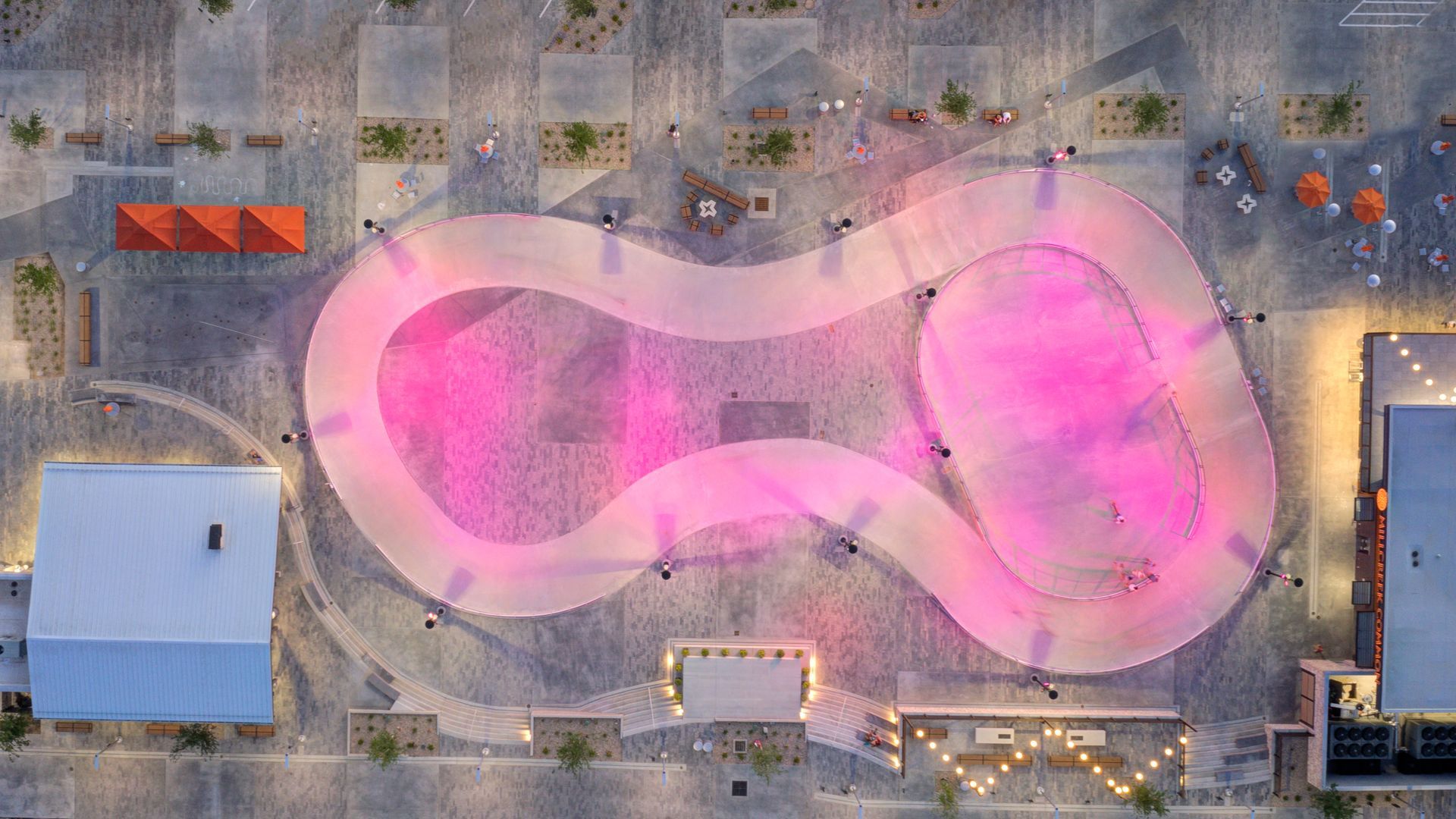
Millcreek Common is a four acre plaza divided into commercial areas for food trucks and restaurants, parking, a splash pad, and staging and community rooms near the 11,725-SF skating oval, which features as the main attraction.
The choice to purposefully jumpstart a downtown may seem backwards, but hop on over to the plaza on a Thursday food truck night and see a city fully embracing its public space.
The labor to bring it all to fruition began a few years ago. After finishing the Bountiful City plaza together in December 2020, Hogan Construction and EPG, a Terracon Company, again joined forces to design and build for a nascent city—an especially challenging project given the location Millcreek chose.
The first hurdle was the 48 properties that needed to be bought and demolished. After going door to door and dialing up residents and business owners, Millcreek purchased all the necessary properties in nine months without using eminent domain, according to Mike Winder, City Manager and Economic Development Director for Millcreek City. This gave the project team the green lot to move forward.
Uncovering the existing site was an adventure through time for the construction team. Demolition teams cleared out everything from homes built in the 1940s to an office building from the 1980s. Excavation teams unearthed long-buried foundations, box spring mattresses, masonry debris from the old brickyard—for which the neighborhood gets its name—and gas lines no one was aware of when verifying with city documents.
It’s a testament to how far construction has come. According to Dennis Forbush, Vice President at Hogan Construction, builders from many decades ago often neglected to warn others on where to dig and what to avoid. “Now, we bring in bedding sand to mark where the [utility] lines are,” he said. Beyond actually mapping out lines, construction teams also leave trails of copper tracer wire and tape to show the city and future excavators where to avoid.
After removing all of the waste material from the site, Forbush said that enough good fill material was readily available, thus reducing structural fill imports and allowing quick movement into construction. But excavation and demolition weren’t the only challenges faced by the project team.
Overcoming Seismic Concerns
The overall site rests on top of the Wasatch Fault, which led to localized design choices. Spearheaded by David Harris, Principal for Planning + Landscape Architecture Services for EPG, design of Millcreek Common features zigzag patterns on the west side of the plaza concrete that represents an abstraction of the 240-mile fault. Design also features LED lights on the splash pad that trace the actual site of the fault.Harris explained how the site, given its fault proximity, has been engineered far above code to ensure the highest level of safety.
Today, the completed Millcreek Common is home to many an event, with city officials noting the great attendance for Pioneer Day, weekend activities, and especially the Juneteenth celebrations. Those interviewed recognized the power harnessed in construction and design to build an active community in Millcreek. Festivities even got Forbush to try Instagram so he could share not just his work, but the enjoyment that has come from Millcreek Common.
Materials Present
He’s not the only one enjoying it. The entire project was informed by an extensive public input process from the project team via open houses and online surveys. One of the inputs from the public outreach brought out the name “Millcreek Common” itself. Other forms of outreach elevated children’s opinions of what they would like to see from the area.
“We worked to really get the opinions from the younger crowd,” Harris explained of the open houses and stations with program elements set up so that children could understand. “They’re the generation that can enjoy this both now and in the future.”
It’s certainly kid-friendly, even if the amenities are available to all. With the splash pad, skating pad, outdoor dining areas, and the flexible, one-way “woonerf”—a Dutch concept involving living streets that seek to flexibly share the space between cars and people—it fits, bringing together everything that the people of Millcreek have in common.
Work on the structures helped bring about the timeless, Millcreek-centric design. Harris described it as a modern take on the “mill town,” with black steel and glass giving the space an enduring and industrial feel, and wood benches and stone to anchor the building to the history of the city.
Small amounts of stadium seating in the form of concrete and wood beams worked with the ten-foot elevation change from the east to west of the site, combining Millcreek’s natural topography with functional beauty to add to the plaza.
Heavy grade three-inch pavers are found throughout the site to add both durability and visual intrigue. Pavers and 27,000 SF of concrete flatwork make up the walking and skating surfaces, which went through a dozen mockups to bring it to the color seen today. On a summer tour, the pleasant gleam of the walking paths comes from the sparkle grain finish of the concrete, while the light broom finish of the oval is a high-quality top for skaters.
Winter months transform the skating oval into an ice skating rink. Cooling tubes underneath the rink were not just an art form during their installation but help to keep the surface ready for split jumps and counter turns from skaters.
It’s a multi-use space for a diverse array Millcreek’s 65,000 residents and anyone else looking for some fun. Flexibility at the site, said Harris, “allows the city to use the space however they deem necessary.” He explained that the European plaza style of Millcreek Common brings diversity and activity to the area all year long.
The assist comes from power pedestals that allow for "plug-and-playability” for the many community events filling up Millcreek Common’s schedule. No need for generators, no need for messy cords for weekend DJ sets at the plaza, community yoga, or food truck Thursdays.


How it Fits in Millcreek
The plaza acts as a yard for the public “house,” the initial phase of a master plan that, when completed, will be a place for residents to live, work, and play. Master-planned alleys and parks will keep everything on the full site completely walkable to multi-family developments under construction and existing and future retail nearby.
The project team talked about “building the front yard first” instead of a city hall. It is intentional. If you can bring visitors in the beginning, the logic goes that retailers will follow. According to Winder, this approach will help to keep precious financial resources away from tax increment financing and instead collect revenues from development within the city as developers meet demand by building projects nearby—housing, retail, office, etc.—a win for the city, developers, retailers, and residents.
“It’s a once in a lifetime opportunity. It gives [Millcreek] a definite identity,” said Harris of creating a city and city center from scratch. And the new downtown for Millcreek doesn’t stop there. The fully master-planned space will include a city hall, set to complete construction in August 2023, alongside additional amenities that add to the good work done by Millcreek Common.
Harris said that the commitment to not just building, but operating Millcreek Common is going to lead to not just an emerging downtown, but a growing sense of community for the youngest city in Utah. What began with proactive city officials enlisting an all-star team to build an awesome community space is today an anchor of Millcreek’s emerging downtown.
Millcreek Common
Address: 1354 E Chambers Ave, Millcreek, UT 84106
Owner: Millcreek City
Design Team
Architect: EPG, A Terracon Company
Civil: Horrocks Engineers
Electrical: BNA Consulting
Mechanical: WHW Engineering
Structural: Dynamic Structures
Geotech: Ninyo and Moore
Landscape: EPG, A Terracon Company
Construction Team
General Contractor: Hogan Construction
Concrete: Kenny Sang
Plumbing: 7PHE
Electrical: Arco Electric
Masonry: AK Masonry
Drywall/Acoustics: Wallboard Specialties
Painting: Hegemann Paint Co.
Tile/Stone & Flooring: DesignTeam
Carpentry: RJP Construction
Roofing: D-7 Roofing
Glass/Curtain Wall: NbI Glass
Steel Fabrication: JT Steel
Steel Erection: Hogan Construction
Excavation: TEC Excavation
Demolition: Perez Company
Precast: Brailsford Cast Stone Inc.
Landscaping: Clearwater Landscaping