Whitaker Construction tackles myriad challenges including deep excavations, a massive steel pipeline, and a maze of existing utilities on this generational $57 million project connecting Big
and Little Cottonwood Water Treatment Plants.
By Bradley Fullmer
Building a 3.3-mile water transmission pipeline is challenging enough. Building it through established neighborhoods, beneath active streets, around existing utilities and alongside an aqueduct that has been delivering water to the Salt Lake Valley since the 1930s takes the degree of difficulty to another level.
That is the environment Brigham City-based Whitaker Construction has faced on Cottonwoods Connection Schedule C, a major piece of the Salt Lake Aqueduct Replacement (SLAR) pipeline jointly owned by the Metropolitan Water District of Salt Lake & Sandy and Salt Lake City Department of Public Utilities.
Whitaker broke ground in spring 2024 on the approximately $57 million project, with work extending through Q1 2027. The project includes more than 17,000 feet—approximately 3.3 miles—of 60- and 72-inch welded steel transmission pipe running through Cottonwood Heights.
The new pipeline parallels the existing Salt Lake Aqueduct and connects the Big Cottonwood Water Treatment Plant near the mouth of Big Cottonwood Canyon with the Little Cottonwood Water Treatment Plant. When operational, the connection will allow raw water from Big Cottonwood Creek to be directed to either treatment plant.
That flexibility is particularly important as the Big Cottonwood Water Treatment Plant prepares for a major reconstruction. But the benefits extend well beyond the immediate project, creating additional redundancy and operational flexibility within a critical regional water system serving the Salt Lake Valley.
Getting there has required Whitaker to navigate some formidable construction challenges.
"This project is certainly one of the more complex jobs I have personally worked on, but Whitaker has been building challenging infrastructure projects since 1953," said Dallen Christensen, Project Manager for Whitaker Construction.

Slide title
Photo by Dana Sohm, Sohm Photografx
Button

Slide title
Photo by Dana Sohm, Sohm Photografx
Button
Slide title
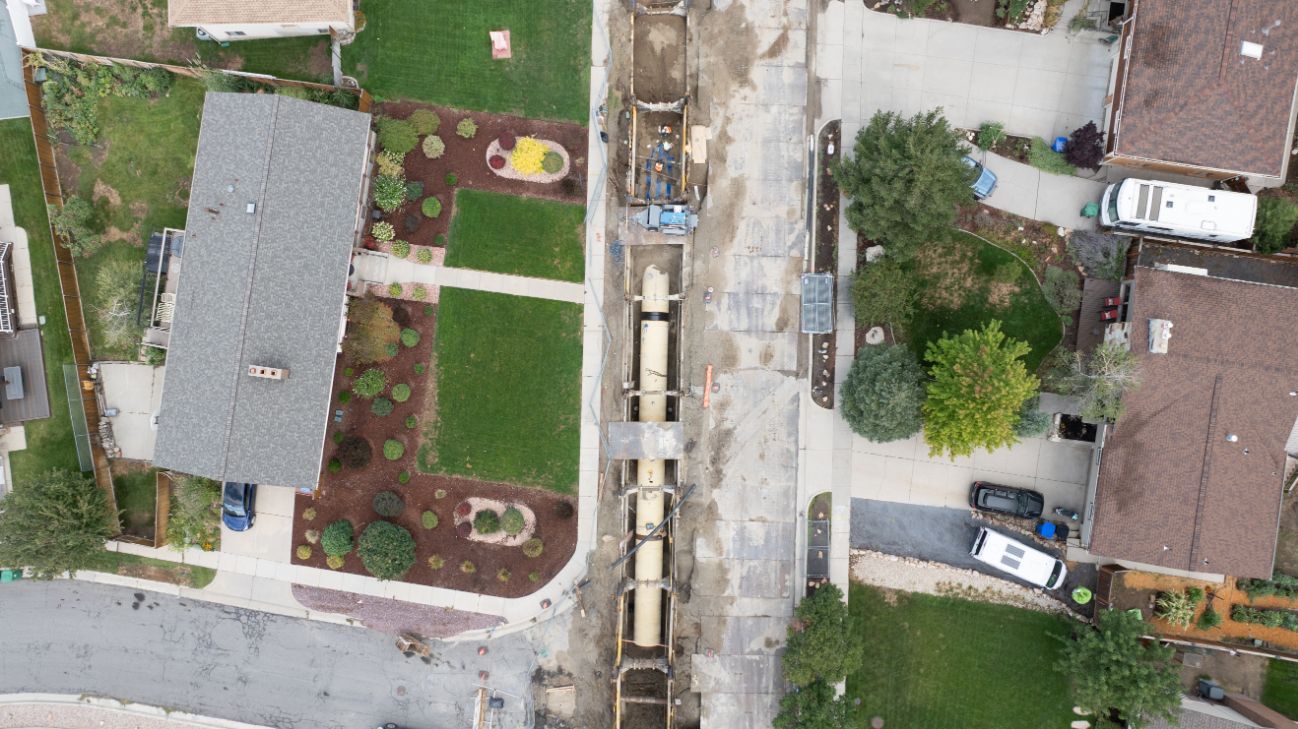
Aerial views of two different sections of work happening simultaneously in Cottonwood Heights.
Photos by Dana Sohm, Sohm Photografx)
Button
Three Miles Through an Established Community
Unlike a transmission pipeline built through undeveloped land, Cottonwoods Connection Schedule C passes through an intensely developed urban environment for nearly its entire length.
"The alignment runs directly through established neighborhoods for nearly the entire project," Christensen said. "With private property on both sides, every easement situation is different."
The alignment impacts nearly 70 residential properties, requiring significant coordination among Whitaker, project owners, engineers and individual property owners before construction crews arrive.
Some easements are relatively straightforward. Others are anything but.
"The team has worked proactively on property coordination to help ensure residents are properly notified and given adequate time to address site-specific impacts before crews arrive," Christensen said.
Those impacts can include virtually anything homeowners have constructed within or near the pipeline easement.
"Many of the properties present unique considerations, including existing structures and amenities located within the alignment such as sheds, hot tubs, fencing, and tennis courts, all of which require careful planning for removal, protection, and restoration once pipeline installation is complete," he said.
"In some areas, excavations have exceeded 25 feet in depth to safely navigate unavoidable conflicts.
Maintaining progress requires constant field coordination and the ability to adapt to changing conditions in real time without impacting momentum across the remainder of the alignment." —Dallen Christensen
At the same time, crews must maintain traffic, preserve access to homes and businesses, coordinate with multiple utility owners and keep residents informed about construction activities.
And while all of that is happening above ground, conditions beneath the surface present another set of challenges.
Crews have encountered unmarked fiber lines, conflicting sewer and water lines, unknown crossings and other existing infrastructure. In some locations, navigating those conflicts has required excavations exceeding 25 feet.
"On a project of this size, underground conditions can change significantly throughout the alignment, and unforeseen conflicts are a normal part of construction," Christensen said.
Working around those conflicts without sacrificing momentum requires decisions to be made quickly in the field.
"In some areas, excavations have exceeded 25 feet in depth to safely navigate unavoidable conflicts," Christensen said. "Maintaining progress requires constant field coordination and the ability to adapt to changing conditions in real time without impacting momentum across the remainder of the alignment."

Slide title
Photo by Dana Sohm, Sohm Photografx
Button
Big Pipe, Deep Trenches
The sheer scale of the pipeline adds another dimension.
Whitaker is installing 60- and 72-inch-diameter welded steel pipe—sections large enough for a worker to comfortably stand inside. Each section must be positioned, aligned and field-welded before undergoing inspection and testing.
Every welded joint receives full nondestructive examination to meet potable water requirements. Individual welds can take six to eight hours to complete.
"Every joint must be welded, fully inspected, tested, and wrapped before work can continue," Christensen said. "There are no shortcuts when building these large-diameter pipelines."
That means pipe installation is far more involved than simply excavating a trench and lowering sections into place.
"Every pipe section across 3.3 miles requires close coordination between welders, inspectors, testing personnel, coating crews, and field operations," he said.
Where excavations reach significant depths, Whitaker is utilizing slide rail shoring systems to maintain safe working conditions while limiting the excavation footprint within narrow urban rights-of-way.
The project also includes multiple turnout vaults connecting the new SLAR pipeline with existing Salt Lake City water transmission lines at Nutree Drive, McEntire, 7000 South, Creek Road, Bengal Boulevard and Danish Road, along with utility relocations, gravity block retaining walls, pipeline appurtenances and fiber-optic conduit installation.
Several connections involve welded tees tied directly into active Salt Lake City transmission mains ranging from 10 to 20 inches in diameter.
Those cut-ins must be coordinated around system pressure, demand and operating schedules—because the existing water system does not stop simply because construction is underway.

Slide title
Photo courtesy Whitaker Construction
Button

Slide title
Photo courtesy Whitaker Construction
Button

Slide title
Photo courtesy Whitaker Construction
Button
Building Beside a Working Aqueduct
Perhaps the most important constraint is the infrastructure already in the ground.
The new SLAR pipeline is being constructed beside an existing aqueduct that has served the Salt Lake Valley since the 1930s. That system must remain operational throughout construction.
"The project also requires close coordination with the existing water systems and entities," Christensen said.
Every connection into an active Salt Lake City transmission line has to be scheduled around the needs of the larger water system.
Those needs can change.
During an unusually hot and dry summer, elevated water demand extended farther into the fall than anticipated, reducing available windows for some connections and forcing the construction team to modify sequencing.
For Whitaker, maintaining the schedule has therefore depended less on rigidly adhering to an original construction sequence than on developing enough flexibility to respond when circumstances change.
Two Crews, Two Headings
One of the most consequential adjustments came early in construction.
Whitaker transitioned from a single mainline pipeline crew to two independent headings, allowing two crews to simultaneously install large-diameter pipe at separate locations along the 17,000-plus-foot alignment.
"That approach significantly improved production and helped strengthen the projected completion timeline," Christensen said.
It also provided a critical advantage on an alignment containing so many potential disruptions. If a utility conflict, property issue or other unforeseen condition temporarily slows one heading, work can continue elsewhere.
Christensen is quick to point out that running multiple headings isn't itself a new construction concept. The challenge lies in successfully supporting both operations simultaneously.
"With two active headings running at the same time, the team is constantly looking two to three months ahead on both fronts," he said.
That requires extensive advance potholing and utility coordination, along with management of materials, inspections and pipe deliveries to ensure neither crew runs out of productive work.
"Utility crossings and relocations can easily impact projects of this size because of the number of stakeholders involved and the lead time required for coordination," Christensen said. "Staying proactive with communication and scheduling has helped ensure the crews can continue moving without unnecessary delays."
Large-diameter steel pipe procurement has become a significant logistical operation in its own right. Fabrication and delivery schedules can shift over the course of a multiyear project, requiring Whitaker to continually adjust installation sequencing around material availability.
"In many ways, coordinating pipe production, delivery, inspection, and installation has become a critical operation of its own within the overall project," Christensen said.

Slide title
Photos by Dana Sohm, Sohm Photografx
Button

Slide title
Photos by Dana Sohm, Sohm Photografx
Button

Slide title
Photos by Dana Sohm, Sohm Photografx
Button
Infrastructure Built on Teamwork
For all the project's technical complexity, Christensen said its success ultimately comes down to people and communication.
"The reality of utility infrastructure construction is that every project comes with its own unique challenges," he said. "What separates successful projects is not the absence of problems, but how well the team is prepared to respond to them."
That philosophy becomes particularly important when construction involves multiple owners, engineers, utility companies, residents, businesses and public agencies—all with different priorities and schedules.
"Staying proactive, maintaining strong relationships with stakeholders, and building trust and communication across the entire project team are all critical to keeping work moving forward," Christensen said.
"The reality of utility infrastructure construction is that every project comes with its own unique challenges.
What separates successful projects is not the absence of problems, but how well the team is prepared to respond to them."
—Dallen Christensen
Whitaker's field and management teams have also had to remain closely aligned as conditions evolve.
"One of the strengths of this project has been the level of alignment across the team, from superintendents and project managers to engineers, foremen, operators, and laborers in the field," Christensen said. "When everyone understands the objective and takes ownership in the process, even very difficult challenges become manageable."
Christensen ties some of that ownership mentality directly to Whitaker's structure as an employee-owned company.
"A large part of that mindset comes from Whitaker's culture as an ESOP company," he said. "Every employee has a direct stake in the company's success, which creates a strong sense of accountability and shared purpose across the organization."
That culture has been developed over more than seven decades of infrastructure construction since Whitaker was founded in 1953.
Christensen stops short of labeling Cottonwoods Connection the company's most difficult project, noting that Whitaker teams have successfully completed—and are currently performing—other highly demanding infrastructure work throughout the region.
But Schedule C certainly embodies the kind of challenges heavy civil contractors relish: huge pipe, deep excavations, tight rights-of-way, unpredictable underground conditions, active water infrastructure and a schedule that refuses to stand still.
And when the approximately 3.3-mile pipeline is complete, much of that effort will disappear underground. What remains will be something far more consequential—a stronger, more flexible water delivery system designed to serve Salt Lake Valley residents for generations.