






One for the Ages

Transforming the historic Union Pacific Depot building into a world-class hospitality project required an innovative design and yeoman-like efforts of the entire design and construction team to create a truly timeless hotel.
By Brad Fullmer

The body content of your post goes here. To edit this text, click on it and delete this default text and start typing your own or paste your own from a different source.

Every so often a project comes along that defies logic, particularly in the adaptive reuse of historic buildings. The stunning transformation of the renowned Union Pacific Depot in downtown Salt Lake City into the new Asher Adams Hotel is indeed such a project. 


Originally designed by noted American architect Daniel James "D.J." Paterson and constructed from 1905-1908, the Union Pacific Railroad Depot was a huge economic boon to Utah's early growth at the dawn of the 20th Century, providing economic prosperity and serving as a vital link for travelers and goods between Salt Lake City and Los Angeles and giving Utah's capital a truly historic milestone building. 

With a stately French Renaissance style, the building was retired more than a half-century ago and quickly designated a local landmark and listed on the National Register of Historic Places. The building functioned as an Amtrak station for a decade (1977-86) and served two other train lines into the 90s, but the Grand Hall was little more than an entrance to The Gateway in recent years, despite the north part of the building being converted to popular concert venue The Depot in 2006.


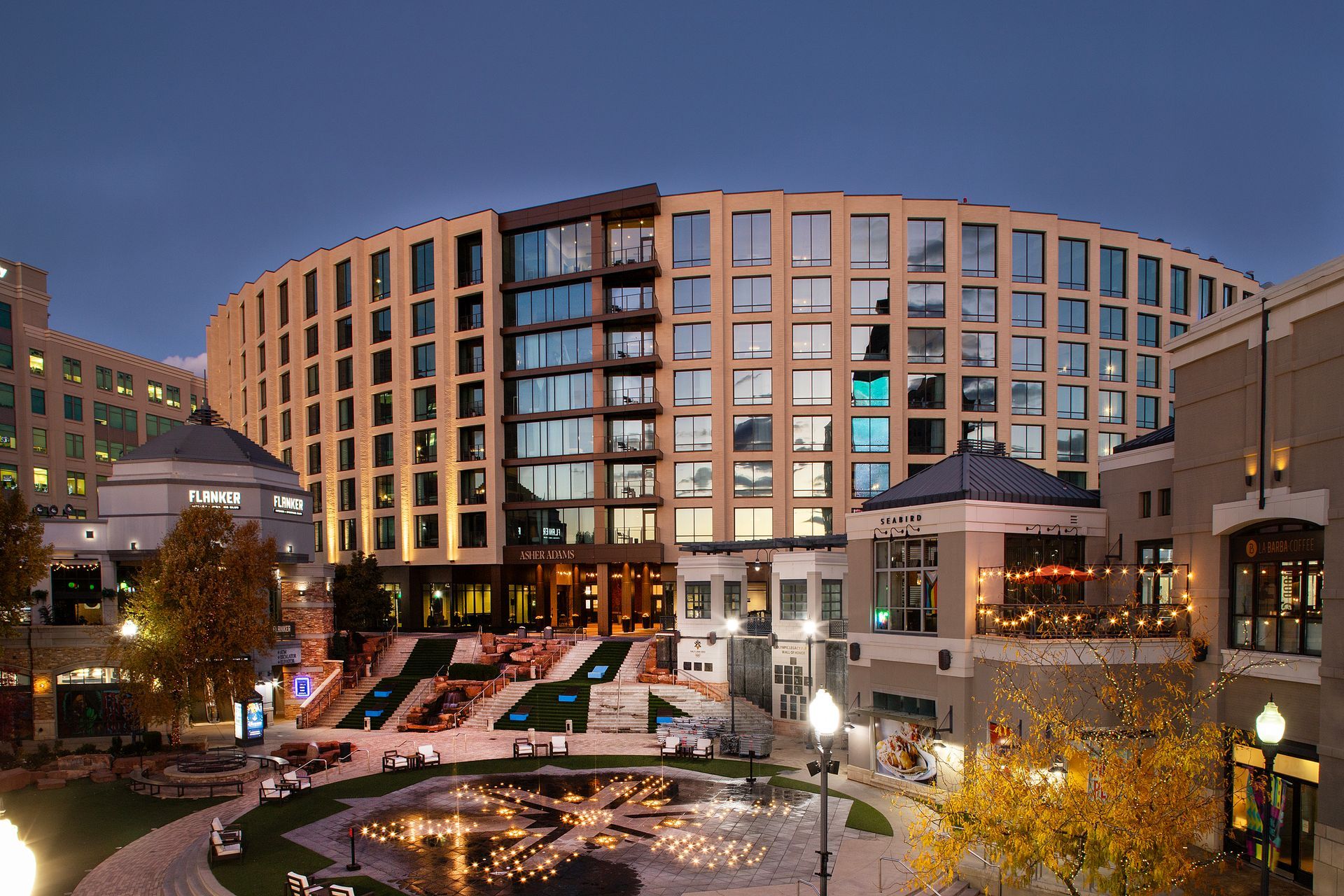
Designed by HKS' Salt Lake office and built by Salt Lake-based Okland Construction, the combined 188,000-SF, $85 million project includes the original historic building that faces east on 400 West, along with an eight-story addition directly adjacent to the west that serves as an exciting new exterior facade for The Gateway. 


After an arduous, six-year-long development process—halted for a while due to pandemic uncertainty—Phoenix-based owners The Athens Group, in partnership with real estate firm Hatteras Sky, have a final project that rivals any new hospitality project in the Intermountain West. 


HKS Principal-in-Charge and Salt Lake Office Director, Emir Tursic, was on the project from day one, beginning with conceptual design plans that started back in 2018. He is thrilled with the final outcome and believes the adaptive reuse project will quickly become one of Salt Lake's most sought-after hospitality destinations based on today's traveler being more sophisticated and inquisitive, with a real desire to learn about the places they visit. 


"Today's traveling consumer is more intellectually curious—they are looking for authentic local experiences and interactions with the local community and its history," said Tursic. "When you have a building like this, that treasures so much of Utah's heritage, it tells a story in and of itself. In our hospitality [sector], we always try to create designs that have a sense of place and history."


Preserving the character of the existing three-story, 45,000-SF structure was critical, as it serves as the entrance to the hotel while ensuring compliance with a public easement that cuts through the Grand Hall. Tursic believes the public easement is an important factor in drawing the local public to the hotel and credits the development team for seeing the value of such a space. 


Tursic said Kim Richards, President/CEO of The Athens Group, is passionate about historic architecture who said,, 'Don't try to design something that's going to compete with the historic building,’" Tursic recalled. "You can't build this [original depot structure] today—even if you had [unlimited] budget, you can't find the materials, you can't find the craftsman to execute this."


The hotel is named after John Asher and George Adams, legendary cartographers who drew the original railroad maps of the West. The majestic grand hall and lobby space is simply exquisite and hearkens back to an era of intricately designed public buildings that served as thriving community hubs. 


The upper levels of the south wing were converted into 13 signature hotel suites—including the stylish Asher suite—while the ground level includes various spaces meant to activate the grand hall. The historic building is shrewdly complemented by a new, eight-story guest room tower located west of the existing building and offering 214 guest rooms, meeting spaces, and back-of-house support. The tower is highlighted by a dazzling penthouse suite—the Adams Suite—on the 8th floor. 


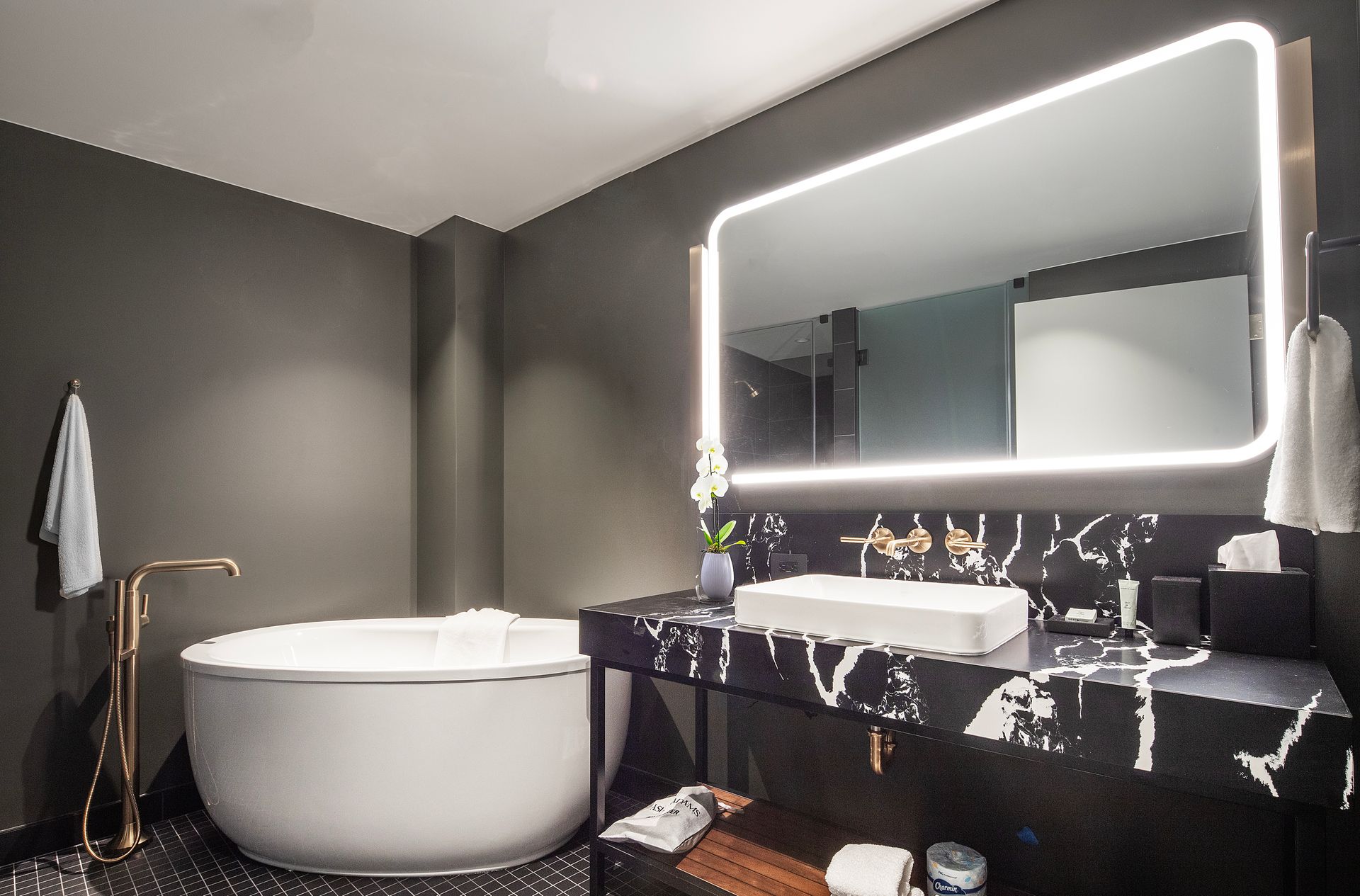
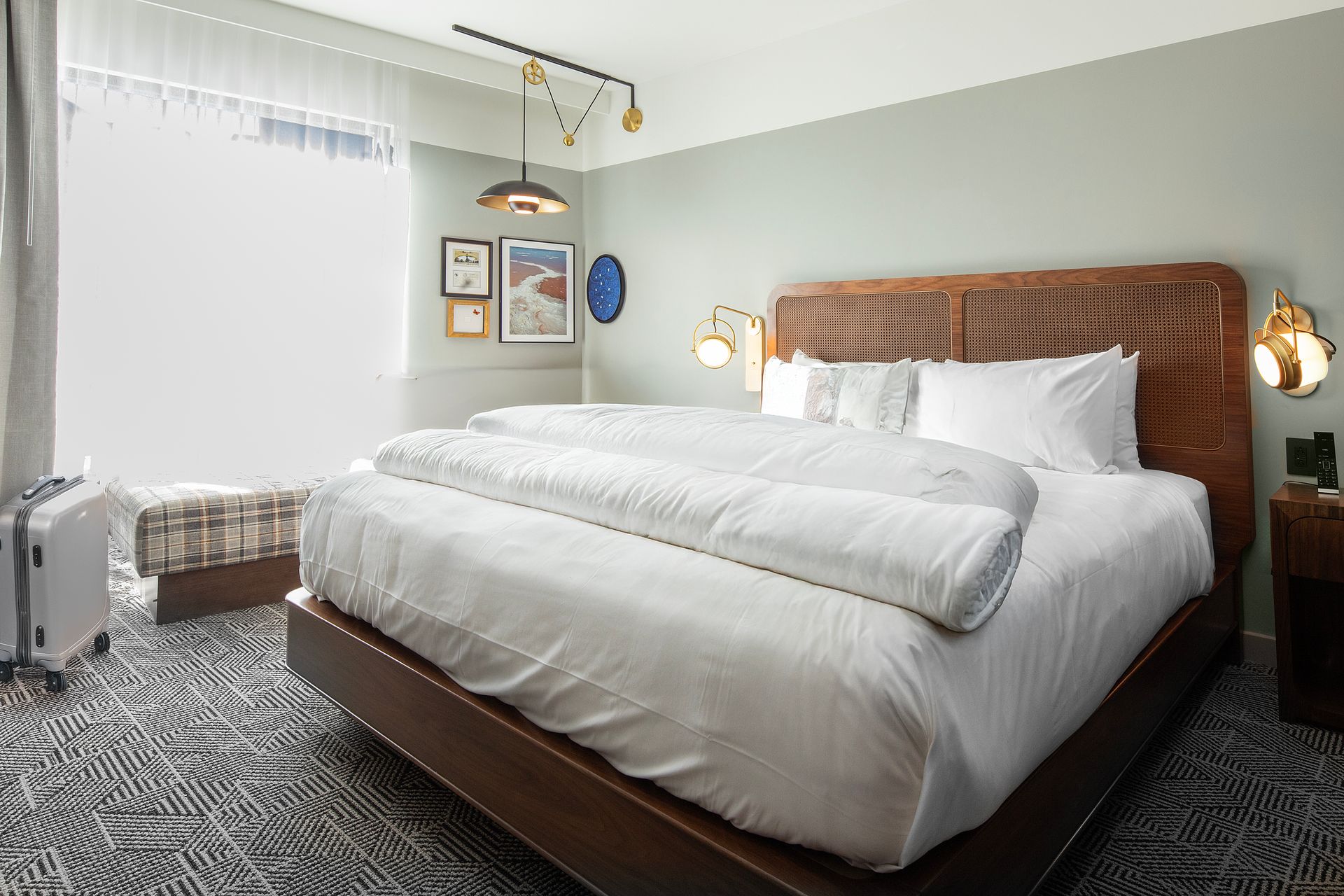
Guest rooms and suites pay homage to the early 20th century with vintage decor and functional amenities, with suites including exposed brick, large picture frame windows, spacious tubs and well-lit bathrooms, brass furnishings, and a mixture of warm colors and a variety of materials and textures. 

Strategic decisions and creative design solutions addressed the complexities of the site, including the existing public access easements around the building, a popular nightclub operating on-site, and preserving public access through the grand hall. 


Tursic said his firm carefully studied historic hotel spaces such as the former Hotel Utah (now the Joseph Smith Memorial Building), which served for decades as a key downtown community hub for locals and visitors to the Beehive State. 


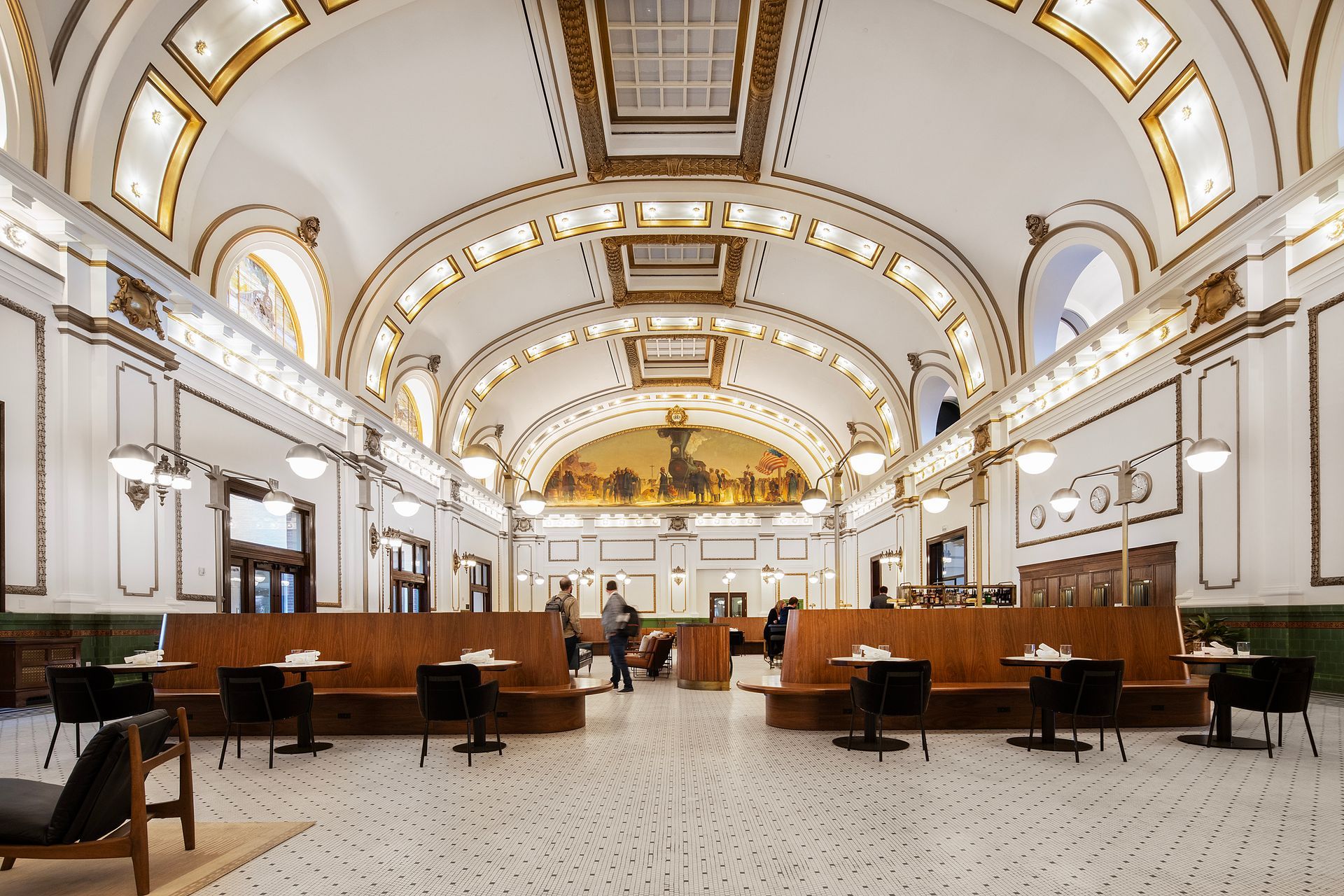
"We had a goal of restoring the character and spirit of the original building, and our inspiration came from those grand hotel lobbies," said Tursic, with the Grand Hall serving as a vibrant heart of Asher Adams. Original murals, stained glass, skylights, arched windows, and decorative molding were all preserved and enhanced to reflect the station’s historical prominence, with myriad retail, restaurant, and entertainment options around and within the Grand Hall creating an optimum gathering space for guests and locals. 
Leaning into New 

Construction Technology

The entire historic structure was scanned using point cloud technology to preserve historic building elements and coordinate the intricate interface with the new addition. The design team used the point cloud file to maximize the preservation of the historic building and artifacts, while minimizing conflicts with new design elements. Later in construction, the point cloud file was used by the construction team to enhance clash detection between field trades. 


A highly constrained site led architects to design a unique curvilinear guest room addition that maximizes usable space while respecting the scale and character of the original building. The radial form originates from a single work point located in front of the historic building that was laid out using special laser technology.  This resulted in creative pie-shaped guest rooms with non-parallel walls requiring special interior finish consideration. While the guest room demising walls were radial, the closet and bathroom walls within were orthogonal, requiring close dimensional coordination and detailing during the design and construction phases.  The radial organization of the new addition required special consideration by most trades, including complex installations of plumbing and mechanical system runs by Salt Lake-based Archer Mechanical.


Archer also installed an advanced drainage system, plumbing fixtures, domestic water supply lines, hydronic fan coil unit piping, multiple air handling units, and a state-of-the-art mechanical room. These systems were expertly integrated into the existing central plant infrastructure to ensure reliable operation throughout both the historic and new building. 


"It certainly is one of the more complicated jobs we've done," said Tony Rickards, President/CEO of Archer, adding that his team couldn't be more proud of its overall quality of work. 


From a construction standpoint, Okland Project Director Matt Cederholm said there were several significant challenges, including the radial design of the structure, preserving and working around delicate historic elements, and the various unknowns that come from restoring a historic building. 


"Every renovation project presents its own challenges with the only constant being that there will be unexpected design and construction impacts that cannot be known until you encounter or discover them during demolition and reconstruction activities," said Cederholm. 


Regarding the new tower and its complex rectilinear planes faceted along a curve, he said the radial design imposed challenges. 


"The corridors and rooms follow the radius of the building and therefore all straight or square walls required point-to-point survey to set the layout of the building instead of standard layout methods by pulling between two gridline points,” he said. "The two structural cores were constructed with 12-inch to 18-inch thick radial walls—even the core couldn't be square."


In addition, crews placed 220 auger-cast piles with an underground, interconnected grade-beam structure to support lateral forces of the radial structural cores. Walls in the Grand Hall were built using gypsum blocks in lieu of two-by-fours and gypsum sheets. 


Cederholm also pointed out that the existing historic building, while experiencing various seismic events over its nearly 120-year history, has several elevation changes. He said this posed one of the bigger challenges in terms of coordinating finishes and elevations within the rooms. Tight site conditions meant the project had one access and egress point for all major equipment used on the project.


"That presented challenges with craning operations, deliveries, concrete and pump trucks, as well as excavation activities," he said. "There wasn't any room to turn around, so trucks and equipment had to pull in and back out." 
  • Slide title

    Write your caption here
    Button
  • Slide title

    Write your caption here
    Button
  • Slide title

    Write your caption here
    Button
  • Slide title

    Write your caption here
    Button
  • Slide title

    Write your caption here
    Button
  • Slide title

    Write your caption here
    Button
  • Slide title

    Write your caption here
    Button
  • Slide title

    Write your caption here
    Button

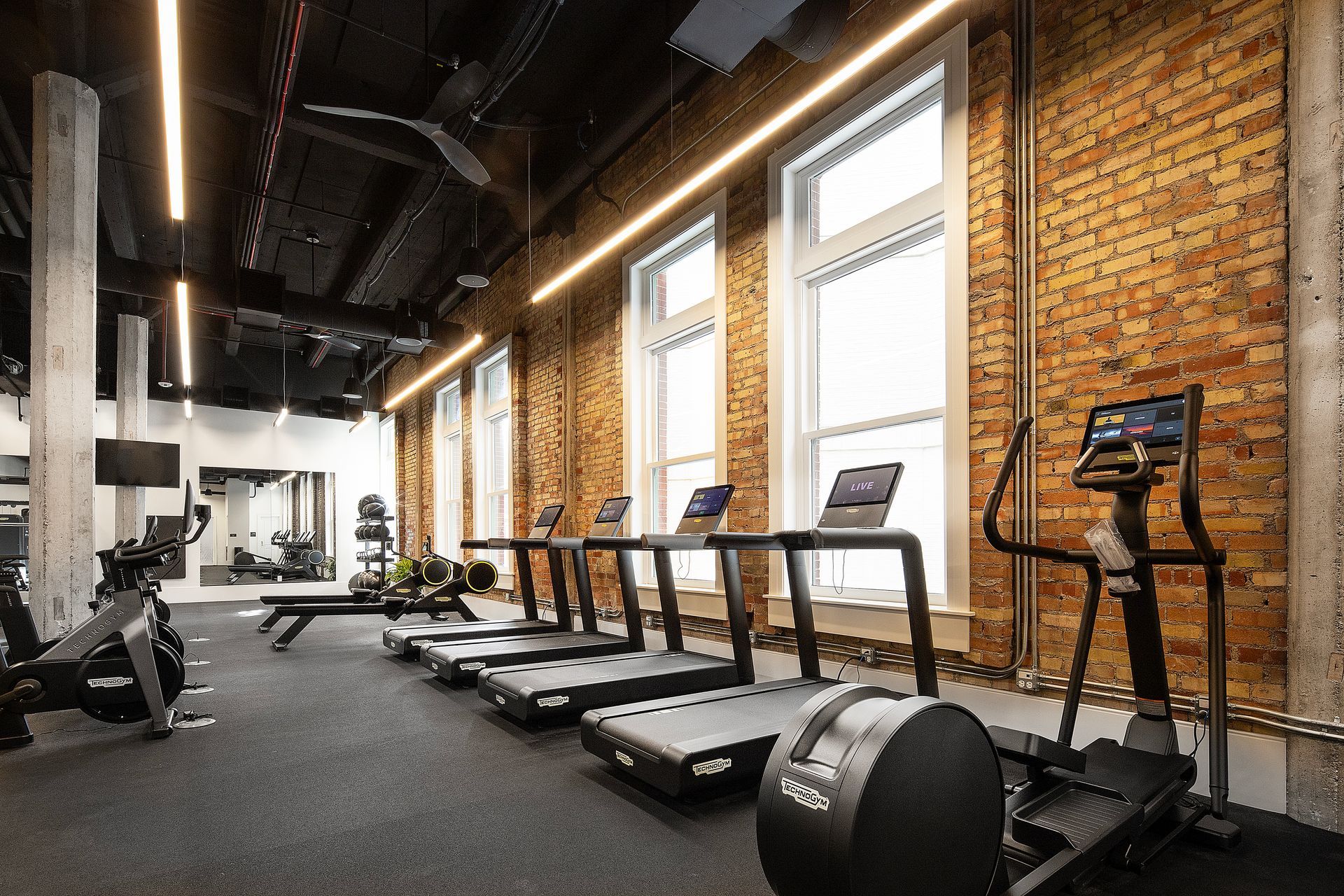
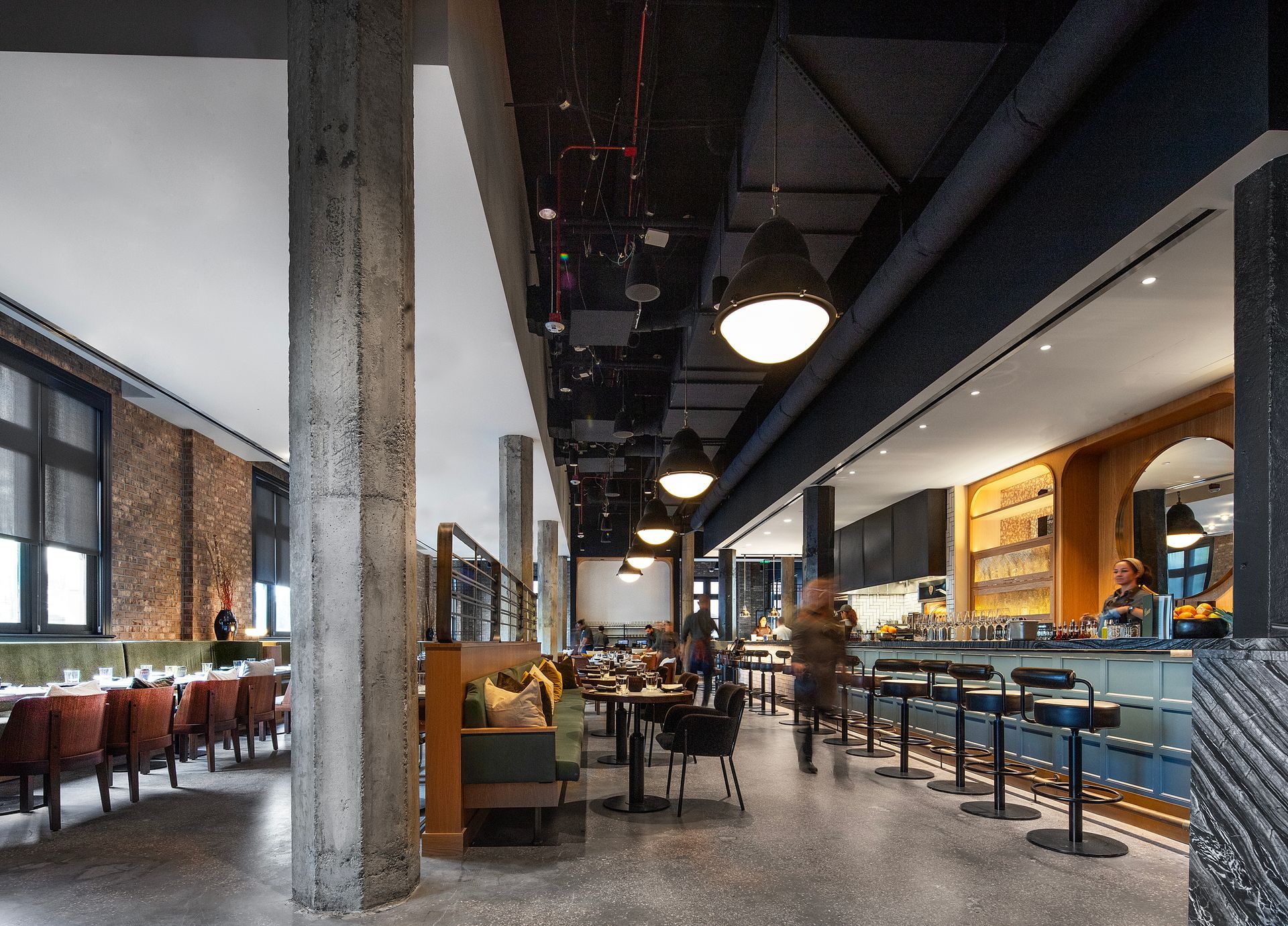
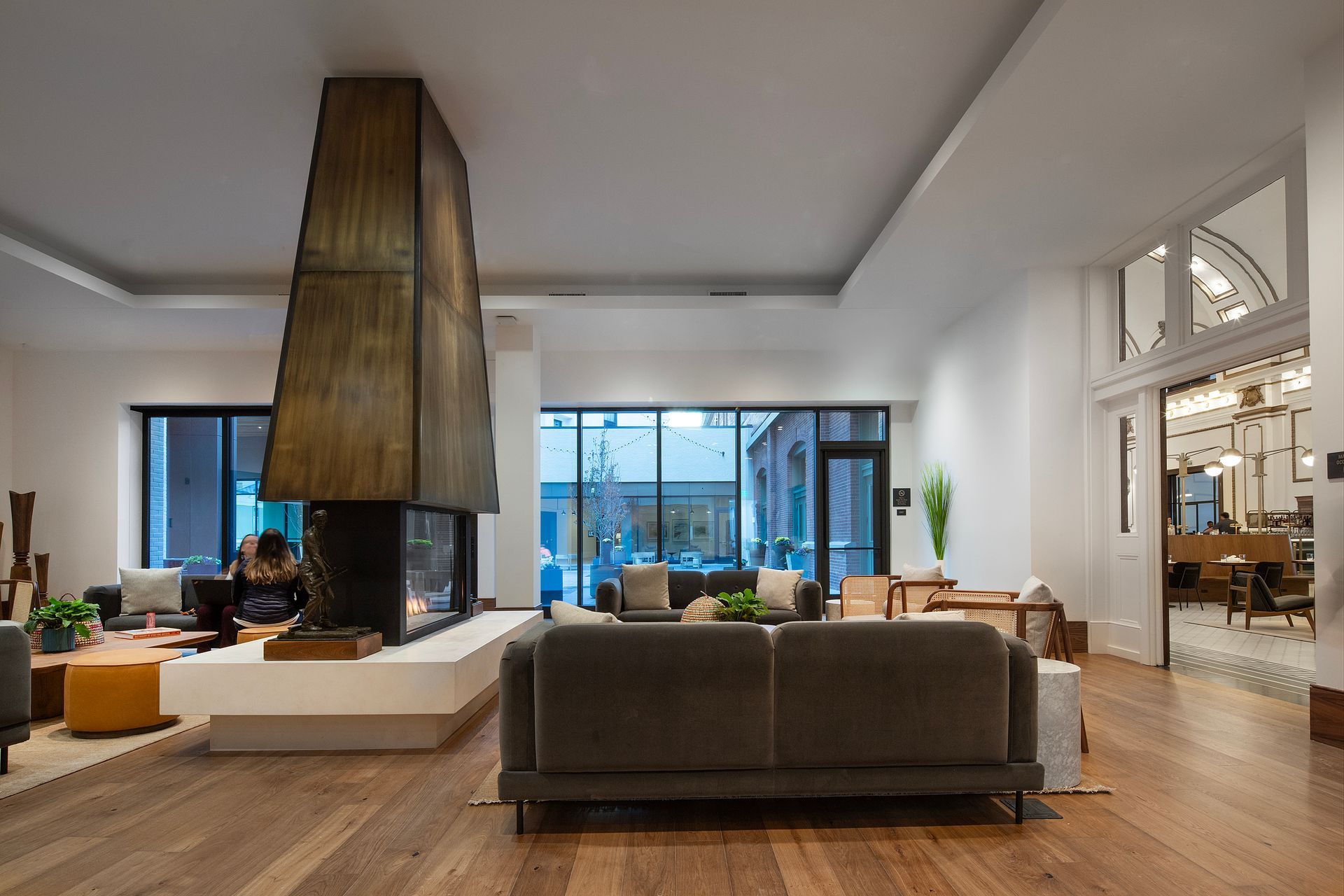
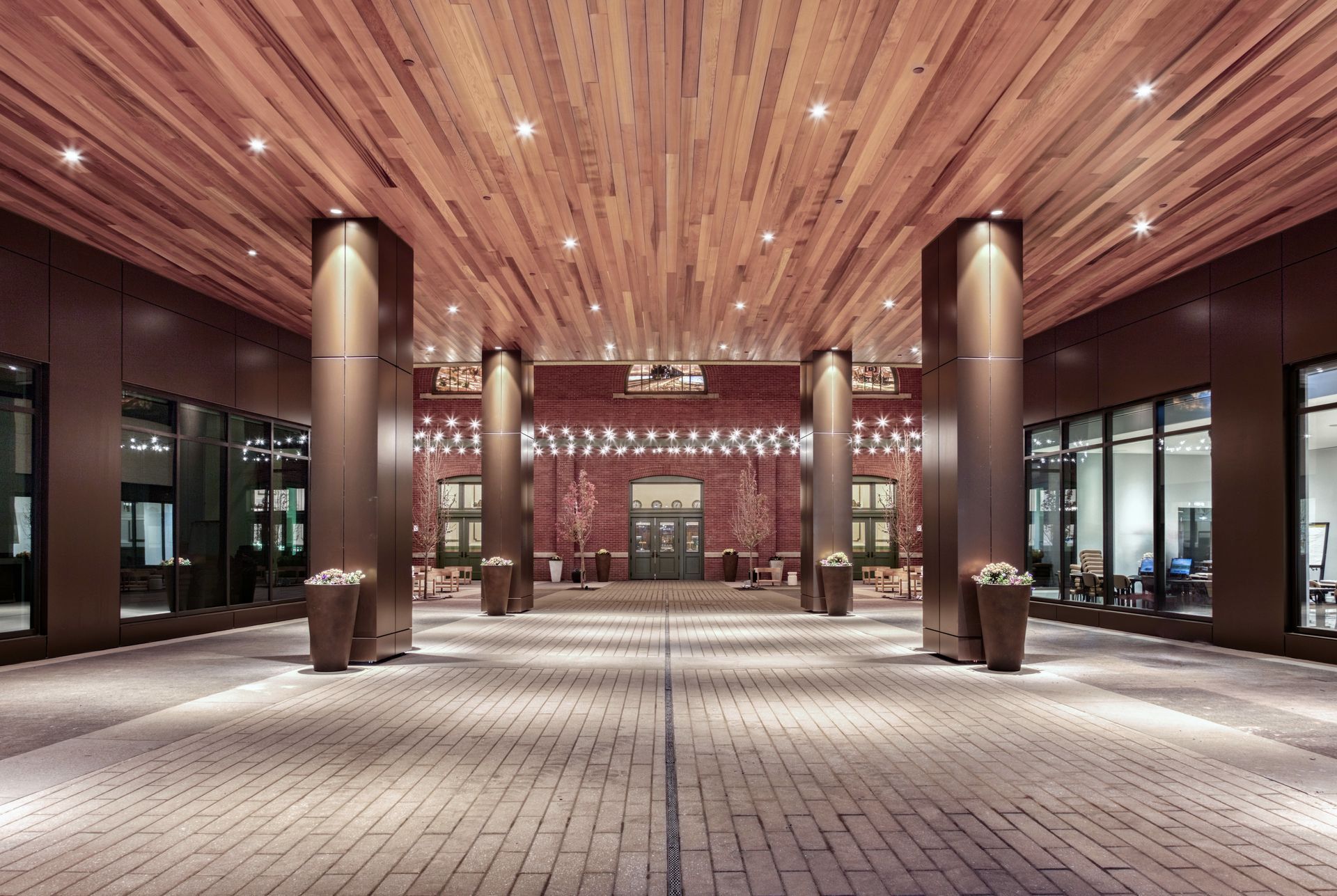
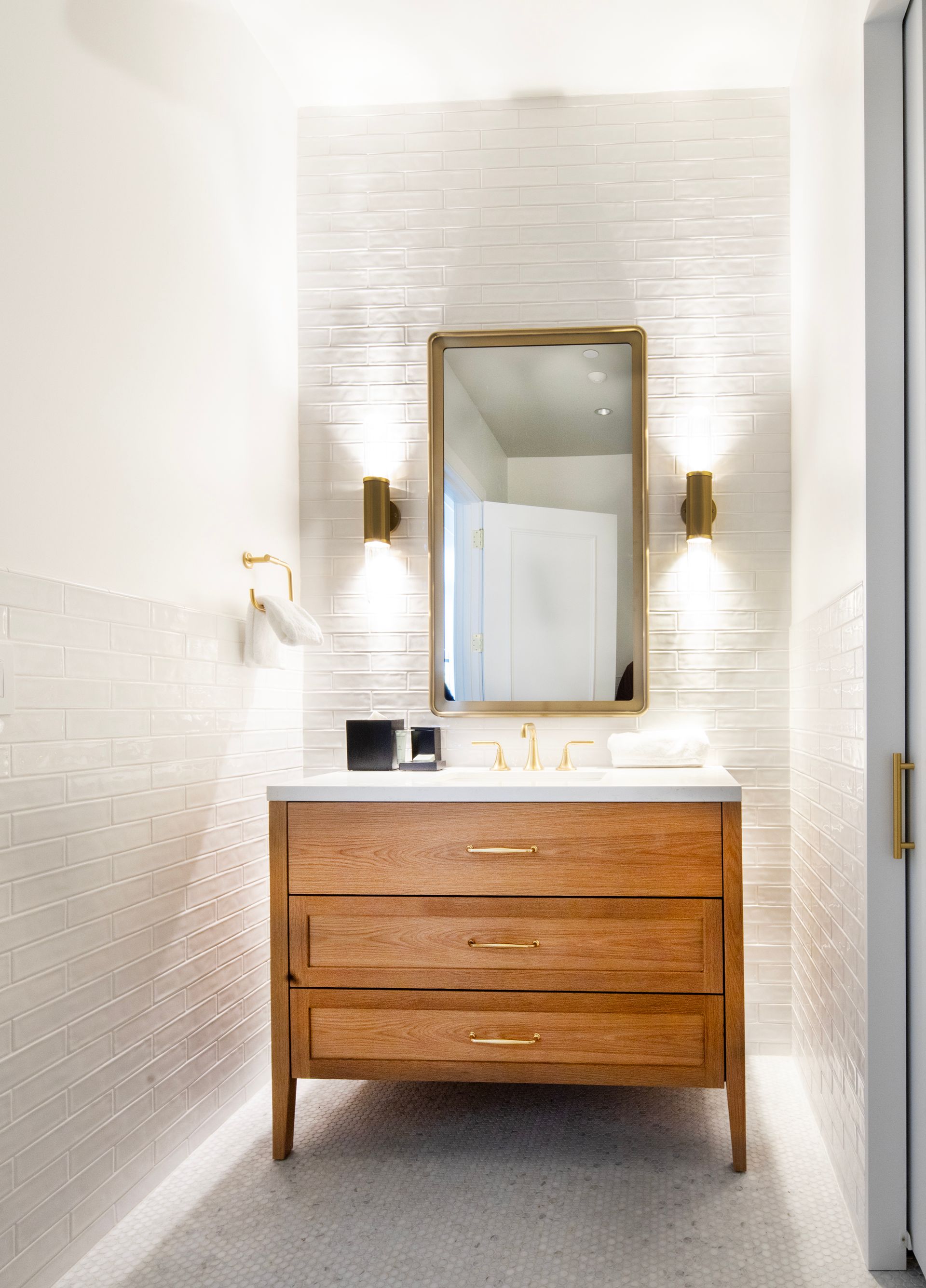
The Grand Hall was transformed into one of the most exquisite hotel lobbies one could imagine. The west side entrance (pictured) is an exceptional plaza space with a rich, warm wood ceiling and rectangular pillars.  Guest rooms are quant and stylish, while top-shelf amenities include a modern gym, hip food and beverage options, along with easy access to mass transit. (interior photos courtesy Okland Construction, by Scot Zimmerman Photography; west side exterior entrance courtesy HKS, by Alan Blakely Architectural Photography)

Top Shelf Amenities;

Timeless Charm

Dining options at Asher Adams include Rouser, a New American-themed restaurant with an open kitchen on the ground floor; No. 119, a whiskey-focused bar on the third floor off the Grand Hall that offers a gorgeous view of the South Temple corridor (Tursic's favorite street in SLC) and the Delta Center to the east; and the Bar at Asher Adams, inspired by the opulence of classic train travel. Additionally, Café Counterpart offers a casual option for coffee and market items.


"I couldn't be happier," gushed Niels Vuijsters, General Manager of Asher Adams and a long-time veteran of the hospitality industry. "The architecture and design of this building drew me to the project. I think the use of the historical aspects and blending them with new, modern aspects is what really has brought success to this property."


Despite being in a market with a lot of other Marriott hotel properties, he said, Asher Adams is part of the hotel magnate's Autograph Collection and offers a different feel and vibe based on its fascinating history. 


"There are stories we have to tell, not just the architectural features—it's the Union Pacific train history and the people in the murals and the stained-glass windows," Vuijsters said. "The naming of all our spaces and how that ties it all together—that’s what makes this place even more special. We're living and breathing [the design] through our services."


Beyond the historic space, Vuijsters said the new tower and office spaces are also far beyond standard hotel options. Tursic asked Vuijsters what he thought about the main employee workspace—a term he said he recently coined as "heart of the house" vs. back of the house, and the response was overwhelmingly positive. 


"[Touring this space] was part of our hiring process," said Vuijsters. "I did so many tours through it, not just with prospective clients but with prospective employees and team members, and I articulated to them that this is going to be your future office, and they were [impressed] with the floor-to-ceiling windows. It was a huge selling point. [Often] in hospitality, you end up in a basement or stuck in some nook and cranny. Here, we have very aesthetic spaces for both front and back of houses."


"Owners are recognizing how important it is, especially since the pandemic, to attract and retain good talent in this industry," added Tursic, emphasizing the need for vibrant employee workspaces. 


This high-end hotel also illustrates downtown Salt Lake’s recent growth in the hospitality market, with the Hyatt Regency Salt Lake City and the dual Marriott branded Le Meridien and Element hotels opening in 2022 and 2023 respectively.


Asher Adams

Owner: The Athens Group 

Architect: HKS Architects

General Contractor: Okland Construction

Civil Engineer: Great Basin Engineering 

Electrical & Mechanical Engineer: BLUM Consulting Engineers

Structural Engineer: Reaveley Engineers

Interior Design: JNS Architecture + Interior Design

Landscape Design: MGB+A Studio

Geotech: Gordon Geotechnical Engineering

Concrete: Okland Construction

Plumbing & HVAC: Archer Mechanical 

Electrical: Taylor Electric

Masonry: Nicolson Construction 

Tile/Stone: MetroSurfaces

Glass/Curtain Wall: Steel Encounters

Steel: GEM Buildings, American Steel Erectors

Other Specialty Contractors: A-Core Concrete Specialists, Intermountain Plantings, CSI, Utah Tile & Roofing, Waterproofing West, DFS Flooring, Final Touch, CSI Drywall
By Bradley Fullmer November 15, 2025
Residents have access to a wealth of modern, high-class amenities: Check out this open-air rooftop patio with tasteful lighting, pool, and spacious hot tub—it’s party time! (all photos courtesy Kier Construction)
By LADD MARSHALL November 15, 2025
Steve Green is out in McCornick, Utah. Where is that? And what’s near McCornick? “Nothing,” joked Green, the Sr. Vice President for Wheeler Machinery Co. While he may be far from even the smallest of small towns, with Holden and its 492 residents 13 miles away, he’s close to the site of a major development in data center technology. Isolated on the western edge of the Sevier Desert, the Joule Data Center will also be isolated from the grid—by design. Operation Gigawatt Rolls On Green is one of many energy and power professionals hoping to double Utah’s power generation capacity by 2034 as a part of Operation Gigawatt, an initiative launched by Utah Governor Spencer Cox in October 2024. Utah has long been an economic growth leader; Operation Gigawatt aims to make Utah a power player in energy development by increasing transmission capacity, increasing energy production, strengthening policy, and investing in energy innovation. While Governor Cox’s Operation Gigawatt moves forward statewide, out in McCornick, Green said, “We’re doing operation gigawatt and a half off grid.” The Joule Data Center project team will deliver “In-situ power generation”—power not connected to any electrical distribution or transmission system. It starts with Caterpillar G3520K reciprocating generator sets that produce 1.5 gigawatts of electricity. Waste heat and exhaust from the generators then move through an absorption chiller system as part of the overall systems combined cooling, heat, and power (CCHP) solution, providing much of the water required to cool the data center servers. Beyond the electric power to be generated for the Joule project, there will be 1.5 gigawatts of thermal energy and 1.1 gigawatts of available battery storage to meet the data center's peak electricity needs. Added Green, “And we’re not taxing the local utility grid.” Isolated or Community Power? The massive power capabilities delivered there are impressive, but they reveal a troubling trend in how Utah will double its power generation capabilities. Will it be from well-funded companies looking to power data centers and AI technology separate from the grid? Or will Utah fulfill the mission of Operation Gigawatt by creating power solutions accessible to all? According to Troy Thompson, Chief Operations Officer for Big-D Companies, power generation is about more than supplying data centers. “In my mind, how do we build a billion-dollar hospital downtown that needs ten megawatts of power?” he said, referencing Intermountain Health’s future downtown Salt Lake campus, “let alone the data centers, and manufacturers who we are hoping that will come here?” Ten megawatts of power may pale in comparison to what data centers require, but it is one of many projects seeking regulatory approval to move forward. The Utah Inland Port Authority, the Economic Development Corporation of Utah, and others continue to drive projects and jobs into Utah—data centers, too. But Thompson said he has heard from many potential clients who are hesitant to bring their energy-intensive projects to the state without firm guarantees of available power. Operation Gigawatt and state leaders have embraced an "all of the above" approach to energy sources, extending the design lifespans of coal plants, embracing new technologies and power sources, and developing new power-generating capabilities. While the industry is willing, the operating environment needs rewiring to meet state goals. Changing for 21st Century Needs “With as hot as the Utah market is,” began Eric Haslem, “there are too many obstacles for us to overcome.” The market may be ready to ramp up production, said Haslem, Chief Operating Officer for Vernal-based utility and heavy civil contractors BHI, “But the current system can’t handle it. We have this massive web of transmission and distribution infrastructure that was not designed or built for the power demands of the 21st century.” “In 1970, they didn’t know what a smartphone was,” Haslem said, “let alone AI.” Transmission projects have been developed. Rocky Mountain Power/PacifiCorp’s Energy Gateway South transmission line—a 416-mile, high-voltage 500-kilovolt transmission line that runs from Mona to Medicine Bow, Wyoming—certainly helped when it went live in 2024. Still, it's just one project amidst a plethora of needs. Haslem stated that Utah's growth over the last 10 years meant a large majority of the transmission line's capacity was accounted for when it went live. .
By Bradley Fullmer November 15, 2025
And the King shall answer and say unto them, "Verily I say unto you, inasmuch as ye have done it unto one of the least of these my brethren, ye have done it unto me."—KJV Matthew 25:40 From a social and community impact standpoint, few projects match the value to disabled and special needs individuals as the new Utah State Development Center (USDC) Comprehensive Therapies Building in American Fork. The $36 million, 65,000-SF facility was designed as a "one-stop shop," said Joe Jacoby, President of Salt Lake-based Jacoby Architects, whose team led the project’s design. It consolidates and modernizes myriad services under one roof, including physical therapy, occupational therapy, recreational therapy, speech, language, and hearing resources, and behavioral health resources. In addition, the new building offers full-service medical and dental clinics, an indoor therapy pool, an Autism treatment wing, and workshops for life skills and vocational training—all geared to helping people live independent, authentic lives, while striving to reach their full potential. "This building was very much about accessibility," Jacoby said, "and putting in many different types of resources for these residents—all in one building." Jacoby's firm has significant recent experience in projects that combine education and healthcare for people with special needs. The firm's design of the Sorenson Legacy Foundation Center for Clinical Excellence in Utah State University's College of Education and Human Services earned UC+D's 2016 Most Outstanding K-12 Project. Two years later, the firm earned another UC+D award for the C. Mark Openshaw Education Center for the Utah Schools for the Deaf and the Blind, a project similar to this one in that it contains an array of services, including education and therapy for varying levels of sensory, behavioral, physical, and cognitive abilities. "We've been working on different [design] aspects for many years, starting with a deaf preschool, which led to working with the Utah Schools for the Deaf and the Blind," said Jacoby. "With that came many other sub-specialties, like therapy for behavioral issues, cognitive issues, development disabilities, and even speech, language and hearing clinics. It helps people with a variety of disabilities and serves an underserved population of people."
By Taylor Larsen November 15, 2025
On a fall tour of Utah State University's (USU) Carolyn & Kem Gardner Learning & Leadership Building (Gardner Building), students and faculty are hard at work on a late Tuesday afternoon. Getting here, where USU's business school students could thrive, was a long time coming. The University commissioned the Gardner Building to meet a new mission for the school outside the traditional knowledge acquisition and transfer for which USU has excelled since its founding in 1888: Giving students a differentiated experience they cannot get anywhere else. Purpose Revealed Frank Caliendo, Senior Associate Dean of the Huntsman School of Business, said that the new building is the third and final piece of the business complex, "a realization of the longtime vision of Dean Douglas Anderson, the driving force behind the school's transformation, to meet the needs of students for generations to come." Caliendo, a longtime Aggie (USU BS, '98; PhD, '03), said that, even after the opening of the George S. Eccles Business Building and its faculty offices and classrooms in 1970, growth in business courses eventually outpaced the school's capacity. Jon M. Huntsman Hall's 2016 opening broke the campus bottleneck, with classrooms and other spaces dedicated to business school participants. "But we still needed space for our centers and experiential learning programs," Caliendo said, of the importance of collaborative spaces and differentiated experience for the five programs (see page XX) that would call the Gardner Building home. The design intent for this final piece wasn't a re-creation of Huntsman Hall, Caliendo said of the initial message to MHTN Architects, "But it does need to rhyme with Huntsman Hall." Working within a Busy Environment The first order of business was siting the building just east of the other two business school structures. Stan Burke, Project Manager for Jacobsen Construction, said the Gardner Building was part of a trio of projects that included Ridge Point Hall and a parking garage—three Jacobsen-led projects that utilized the same construction corridor as construction commenced from "An active campus is difficult enough," said Burke of the challenges of simultaneous construction, which required constant coordination amongst the three teams, made a tad easier as they shared a job trailer. "We had to stay cognizant of the school's activities and coordinate with them so that everyone was aware of what we were doing." Coordination went from important to critical, with the three teams meeting daily to discuss coordination and scheduling material and equipment deliveries in 15-minute intervals as the respective construction teams worked on each of the three structures.
By Bradley Fullmer November 15, 2025
Warren and Jennie Lloyd (above) have built Salt Lake-based Lloyd Architects into a well-rounded, versatile firm capable of excelling in both the commercial and custom residential markets, as evidenced by projects such as Snuck Farm in Pleasant Grove (main photo) and this cozy private Powder Mountain based cabin in Eden (below ).
By Bradley Fullmer November 15, 2025
The last five years have been a whirlwind for the Larry H. Miller Company (LHM), with the organization selling the majority of its beloved Utah Jazz franchise in October 2020 for a reported $1.66 billion, followed by the sale of its auto dealership empire of more than 70 properties for a reported $3.2 billion a year later. The influx of nearly $5 billion was parlayed into several jaw-dropping real estate and other corporate purchases, including: —1,300 undeveloped acres within the massive 4,100-acre Daybreak development in South Jordan in April 2021. —Advanced Health Care Corp. in January 2021, a transitional health care provider with operations in eight states (primarily in the west) and 3,500 employees. —The purchase of the majority stake in Swig, a leader in the flavored soda craze, in May 2023. — Partnering with Utah Trust Lands Administration to develop 1,200 acres in Saratoga Springs. — The acquisition of over 1,000 acres near Park City and Hideout will include multi-family units, housing, restaurants, and retail. —100+ acre mixed-use development in an area along North Temple being dubbed “The Power District”; the future home of not only Rocky Mountain Power’s new corporate campus but potentially a ballpark for a future Major League Baseball expansion team. —A reported $600 million acquisition of controlling interest in MLS team Real Salt Lake and NWSL team Utah Royals, along with associated infrastructure, including America First Field and Zions Bank Training Center. —The development of Downtown Daybreak, a 200-acre parcel that this year saw its 30-acre Phase I debut with the completion of the Salt Lake Bees' new 8,000 capacity stadium—dubbed The Ballpark at America First Square—in April, followed by a new Megaplex cinema entertainment center in July with luxury theatres, bowling, games and a scratch-made kitchen in addition to an open air plaza. A seven-story, 190-unit multi-family development is currently under construction and rising along the right field bleachers, with views that will look down into the ballpark upon completion next year. And LHM is just getting started, said Brad Holmes, President of Larry H. Miller Real Estate since 2018, calling Downtown Daybreak a "new urban center that is central to where the majority of growth is occurring" and combines a "full spectrum of business and year-round entertainment, culture and connectivity, as well as a wide range of housing options." When LHM executives first conceived of a new home for the Salt Lake Bees, Holmes said they went on a "ballpark tour" of MLB and minor league stadiums, and "really fell in love with a ballpark" in Durham, North Carolina—home of the Durham Bulls—which had buildings that framed in the stadium. So, The Ballpark at America First Square has the multi-family project underway in right field, with a proposed hotel slated to begin next year in left field. "In another two seasons, you'll have this urban setting for the ballpark that frames the mountain views. [The design is] really intentional, and I think it will bring a finished edge to Downtown Daybreak," said Holmes. "It was a process trying to figure out the best location, site plan, traffic, but it's in a great spot. The goal for us was to make it feel like it fit in with the community, almost like having a baseball stadium inside of a park, with an open corridor that connects to a plaza."  Holmes said the seemingly small 8,000-capacity stadium (about half the capacity of the Bees former home at Smith’s Ballpark) aligns with national trends. "It's better to play in front of a sold-out crowd than in a half-empty stadium. Some new MLB stadiums are at 30,000 [capacity]. The trend is smaller, more intimate venues with closer views of the field."
By Taylor Larsen November 15, 2025
Much has changed about Hogan & Associates Construction since the company's inception 80 years ago. The name may be the most obvious example, the size of the company may be another giveaway, and the difference in markets served might require a double take if the founders could see the company today. But what hasn't changed is the firm's desire to build communities. It has regularly built important, community-focused projects with a similar purpose since the company came to life in 1945.
By Taylor Larsen November 15, 2025
Imagine this: A company has just begun a meeting with the intent of moving forward with a major investment. One party knows something that will help minimize the investment's risk. Should that party tell everyone, it will save money, time, and everyone involved from future headaches. So when should that party spill the beans? At the beginning of the meeting At the end of the meeting At the right time during the meeting Never Bradley Crocker, Director of Preconstruction for Mollerup Glass, has seen how answering this question correctly—and choosing “A”—brings about successful and profitable investment in commercial construction. “I think that [project teams] need to bring in subcontractors early to help guide budgets in general,” said Crocker, detailing how every trade can bring a similar level of expertise to architects and owners by being involved from the beginning of the “meeting”, while the project is in design. Why? “We can vet cost versus performance and find the best value for the performance, which is essential as meeting or beating the budgets gets the project to construction on time,” said Ben Hiatt, Chief Estimator for Steel Encounters. After all, he said, “Nothing moves if budgets are not met.” Design-assist is a positive step forward, where subcontractors assist in matching design intent with a deep understanding of building envelopes to ensure glazing, roofing, walls, and fenestrations perform at their highest level. Glenn Rainey, Salt Lake City Branch Manager, and Larry Luque, Senior Estimator and Business Developer for Flynn Companies, each said efforts in design-assist fulfill what owners and architects want: buildings that meet the design intent and perform at their highest level for as long as possible. It’s not just architects who benefit from that early involvement. “More GCs realize they need us right up front,” said Luque. With teams whose combined experience totals thousands of hours, building envelope contractors stay up to date on changing codes, materials, and specifications, which is highly beneficial to the project. Their close involvement with vendors can help ensure a variety of solutions that meet each job’s needs and help optimize building envelope performance. Consultant Involvement Other parties are lending their expertise. Brandt Strong said building envelope quality has increased with the arrival of more building envelope consultants in Utah and a greater dedication to the building envelope in general. “We had a time where we could say ‘This is a Vegas project, and we have to have the belt and suspenders,’” said Strong, Director of Operations for Mollerup Glass. On Utah projects, the building envelope used to be an afterthought. But it’s changed for the better over the years. “The Utah teams are as sophisticated as anywhere else.” While the markups on shop drawings can draw some ire, both mentioned how working with consultants has led to better, more efficient projects, potentially reducing the need for future repairs by inspecting every material and transition on the building envelope. Said Crocker, “We cannot discredit the envelope consultants’ role in making us, and the industry as a whole, perform at a higher level.” Hiatt credited each party overseeing the building envelope scope for learning and adapting to create a better building environment, specifically in understanding seismic drift and its relationship to glazing, as well as thermal performance and continuity. Improvements to air-barrier coordination and tie-ins to stop water and air leaks are helping buildings operate at peak efficiency. “The architects, general contractors, consultants, and trades have improved their knowledge over the years,” said Hiatt. “Design and execution of façades are better coordinated and executed.”
By Bradley Fullmer November 15, 2025
Taylor Electric proved its mettle on the challenging Salt Lake International Airport, Southeast Concourse project, with their portion of work concluding in October 2023. (all photos courtesy Taylor Electric)
By Bradley Fullmer and Taylor Larsen November 15, 2025
By Bradley Fullmer It's been a whirlwind 18 months for Adam Del Toro and Nick Pexton, who co-founded Fountain Green-based Reliance Engineering Services in May 2024, a company specializing in full-service telecommunications engineering, including design, project management, permitting, and funding and grant applications. Two years ago, Del Toro was more than a decade into his career as a Research & Development Supervisor for natural gas giant Dominion Energy, while Pexton was working for Nephi-based Rocky Mountain West Telcom (RMWT) as a Sr. Director of Business Development, with just over four years at the company. The two had met a couple of years earlier while collaborating on a potential fiber optic network project in Mona that never happened. Neither was particularly content with their respective positions, so when Del Toro got a random call from Pexton in March 2024, the timing could not have been better. "I was planning on leaving the natural gas industry and start my own firm [...] Nick happened to call the day I was putting in my two weeks [at Dominion],” said Del Toro, 39. "It definitely felt like Providence was helping us." "Somebody was looking after us, because the timing was unbelievable," added Pexton, 35. "It's crazy how things lined up." Del Toro is a native of St. George and earned a Bachelor of Mechanical Engineering from Utah State University in 2011. After 2.5 years as a USU Graduate Research Assistant, he joined Dominion Energy in January 2013, where he designed major natural gas systems and structures. Del Toro also earned a Master of Clinical Mental Health Counseling from the University of the Cumberlands (Williamsburg, Kentucky) in 2023, and moonlights as a counselor at The Center for Hope in Springville, where he helps clients address life challenges both personally and professionally. Pexton is a native of Nephi and studied at Utah Valley University from 2008 to 2010, and earned the Certified Telecommunications Network Specialist designation from Teracom Training Institute (2013-2014). Pexton joined Nephi-based Mid-State Consultants, a telecommunications engineering firm, in March 2011 and spent more than nine years there. He joined RMWT in June 2020, gaining experience in project management and operations. After that fortuitous phone call from Pexton to Del Toro, the pair met four times from March to May to "make sure we were aligned on what the company would look like," Pexton said. "It was a pretty quick process," added Del Toro. "We got talking about goals, how to build a general company vision. I trusted Nick's background and experience, and his character, as well. It was a big risk, but I'm a sink-or-swim guy. If those are my options, I'm going to swim!" Since teaming up, the pair have been aggressive regarding company growth, having exploded from just the two of them to 30 employees, with revenues expected to more than quintuple from $560,000 in 2024 to nearly $3 million by the end of this year. Both expect the telecommunication market to be a fruitful, busy market given the need for fiber optics to rural America, in addition to the "Internet for All" initiative in May 2022 that was part of the National Telecommunications and Information Administration's (NTIA) implementation of the infrastructure law that allocated $65 billion to improve high-speed Internet access. Utah, specifically, received $330 million, with the goal of reaching some 40,000 unserved homes and businesses. The firm's location in Sanpete County puts them in the center of the state geographically, and they're committed to working with communities of all sizes to improve their internet capacity. In addition to Utah, Reliance is working in Michigan and Oklahoma, and Del Toro and Pexton expect to land significant future work throughout the Midwest. They want to grow intentionally while ensuring a diversity of revenue streams. "We set some early goals, and we've been able to do really well—we're on track to beat our goals," said Del Toro, crediting the many employees who have joined the firm. "Those individuals took great risks coming on board. We anticipate we'll be even larger next year with the work coming down the pipeline." "Our outlook has been wise," said Pexton. "We've taken into consideration diversification into other sectors—that's a key element. Adam has experience in the natural gas industry, and we want to further our diversification and get into the power side of the industry." Major clients include the federal government (USDA), utility companies, and municipalities, with a focus on rural communities. "We love Sanpete County," said Del Toro. "We value helping the communities we live and work in and providing services that help build up the community and hopefully help the residents." "We depend on repeat work from 18 major clients, and continuously getting work from them," said Pexton. "The minute we stop doing a good job, they can go someplace else. As long as we do a good job, we'll keep getting work." The pair expect Reliance to maintain its explosive growth, perhaps even doubling its employee total in another 12 months. "Next year's [revenue] goal is $4.8 million," said Pexton. "We have confidence in what our workload will be like. We are scaling quite dramatically and want to grow at a healthy pace, where we're not stringing ourselves out too thin. We're in a good position right now."