Work continues to grind forward on the mammoth new Salt Lake City Water Reclamation Facility (WRF)—a critical $850 million project being built by a joint venture of the Salt Lake regional offices of Sundt Construction and PCL Construction that will replace the current facility in North Salt Lake once it's turned over to SLC's Department of Utilities (SLCDPU) in July 2026.
As it stands, this is the second-largest project in City history, trailing only the recent $2 billion-plus Salt Lake International Airport Redevelopment (Phases 3-4 ongoing), and one of the most technically challenging projects in the state.
"We are up for the challenge every day—the magnitude of this thing is unreal," said Manny Diaz, Project Manager for Salt Lake-based Sundt, as he drove around the massive 30-acre site in late-January, a worksite teeming with 300 current employees (it will peak at 400 workers this summer) and myriad complicated structures being built simultaneously.
Diaz is a long-time veteran of the water reclamation facility industry—this project marks plant No. 26 in his own personal history—and he was brought in a year ago by Sundt because of his expertise. When he arrived in Salt Lake at the beginning of last year, it was right smack dab in the middle of what proved to be a record-breaking year for snowfall. "It was quite a welcome to Utah!" Diaz chuckled. "We keep very close tabs on the weather."
And while crews haven't been subjected to the same inclement weather this winter, site conditions are still generally wet and muddy, and the difficulties associated with building the various structures are constant. Crews are nearing the halfway mark, so certainly it's a milestone worth acknowledging, even though a mountain of construction is still left to climb.
"It's such a huge accomplishment to be this far," said Jason Brown, Deputy Director of Public Utilities for SLC. "We've faced a lot of challenges, Covid, material shortages [...] it's amazing to be part of a team that works so well together. We still have a long way to go, but we'll get there. We've made a lot of progress and should be proud, but it's hard to celebrate success with so much work still ahead."
Diaz, along with PCL Project Manager Shayne Waldron, said crews recently achieved a major milestone: one million hours worked, a notable accomplishment.
“Achieving the ‘one million hours worked’ milestone is a testament to the coordination and collaboration required of a project this size," said Brown, adding that the new WRF project benefits from regular and ongoing staff collaboration, under the watch of Sundt/PCL, designers AECOM and Jacobs, and SLCDPU leadership.
“This [milestone] is the culmination of many different efforts,” added Mauricio Ramos, District Manager for PCL’s Civil Infrastructure Division. “From local engineers to pipe layers, journeymen, construction trade workers, foremen, and general laborers, every team member has been instrumental in reaching this benchmark. The collaboration between PCL and Sundt has been a testament to our shared commitment to excellence and innovation.”
"Our crews are working together seamlessly to ensure that the final product meets the goals and needs of the community," said Sam Reidy, Senior VP and District Manager for Sundt. "Celebrating this milestone recognizes the hard work and commitment each member of the project team has made to this project and the Sundt/PCL partnership."
Diaz and Waldron said soil conditions challenged the team right out of the gate and took significant time to stabilize the site.
"At the very beginning, the project was designed to be built on top of where the sludge beds were at, but it turns out the sludge beds were on shaky ground," said Diaz.
"This whole area is young in age, so it's all soft clays and sands," added Waldron. "Soft clays are compressible, so the big issue is settling. It would have [cost] $80 million in piles to shore it up, and then in between buildings you have all the pipe and utility duct banks, so they would almost need to be built on piles."
Waldron said the idea came up to pre-load the whole site, where crews built a flat pad, installed wick drains, then pre-loaded 30 ft. of dirt, with drains going down 125 feet and providing a way for water to be pushed out of the clay. "We had over seven feet of settlement," said Waldron. Crews also set up sophisticated monitoring equipment "to see where ground was settling and what layers were compressing the most. It was really scientific—a lot more than I've seen before."
Diaz said it took six months to haul in the fill dirt where it remained in place for eight months, then took another six months to excavate out—close to one million yards of total material. It was an exhaustive process, with an average of 400 trucks per day and close to 500 trucks hauling 18,000 tons on the best day. Having a cohesive, highly collaborative team of designers and construction experts has been a boon to the project schedule.
Once completed, Salt Lake City’s new WRF will serve over 200,000 residents as well as those who commute downtown to work or visit Utah's capital. It will replace the City’s current—and only—wastewater treatment facility, which is over 55 years old and near the end of its service life. Maintaining reliable operations at the existing facility while constructing the new WRF nearby has been critical for the project’s success.
Since breaking ground in 2019, the project team has completed approximately 65% of structural concrete work as well as soil mitigation, deep foundation work, and the installation of underground utilities.
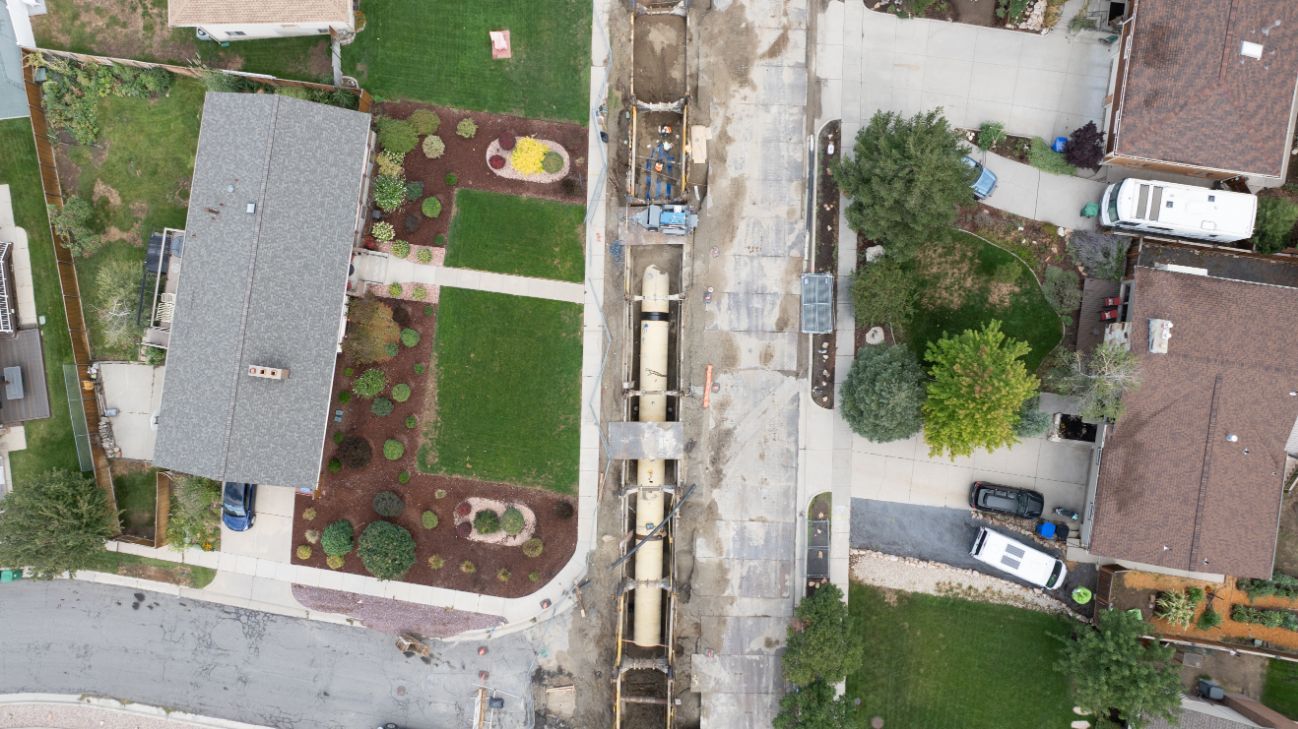
In late January crews began excavating dual 63-in. diameter pipelines, along with a 78-in. effluent pipe that is being hauled one giant piece at a time from Canada, a new type of corrugated HDPE with welded joints that should provide greater durability.
All in all, crews will ultimately pour 93,000 CY of concrete and install 22 million pounds of reinforcing steel, along with 89,000 LF of underground pipe ranging in diameter from 1.5-in. to 78-in.
"The camaraderie among the team members allows for a very cohesive team," said Diaz. "The only way you can tell who works for who is by the color of the truck. We have a 'one project' mentality. The complexity of the job and being trusted to lead this effort [...] have been [important] for me. It's been a great job so far."
Diaz, who said his first wastewater treatment plant was in North Miami Beach in the late 80s right after he graduated from college, hopes to remain in Utah once this job is completed and turned over to the client by mid-2026.
“I plan on staying here and continue to work on treatment plants in Utah,” he said. “There’s a lot of work here. We have vast experience, and we have a lot of people who want to be in Utah—it’s a great place to live. Let’s do it!”