







While Colorado River Compact negotiations reach the finish line, how will Utah’s largest water conservancy districts manage to keep supplying water as the state’s dry streak continues? By Taylor Larsen
Central Utah
Project Name: Alpine Aqueduct Reach 1
Location: Orem
Cost: $100 million
Design & Engineering: Jacobs
General Contractor: WW Clyde
Timeline: March 2025 - Spring 2027


Central Utah
Bruce Ward, Chief Engineer at the Central Utah Water Conservancy District (Central Utah), is hopeful. His boss, Gene Shawcroft, General Manager at Central Utah, has been involved in Colorado River discussions for years as Utah’s chief negotiator.
Is it optimism?
“I’m not sure we have a choice,” said Ward. It’s acceptance. “This is a reality of the West we live in. The water coming down the river is all that we have.”
While the Colorado River gets a lot of attention, Ward explained that Central Utah and its municipal partners are closely monitoring the underground aquifers that supply much of the water for their 2 million users.
“Depending on growth, some aquifers have 7-10 years of healthy aquifer pumping,” said Ward. “At that point, we reach a place of safe yield, where what’s going in is coming out.”
Central Utah wants to avoid “mining” the aquifer, or taking more out of it than is naturally replenished over time. Because, Ward said, whether it comes from the underground aquifer, Colorado River, or sits in the Great Salt Lake, all water is related and interdependent—“One Water”, he said of the industry term.
Even with competing interests and different water rights, Ward said Central Utah and its partner cities are rowing in the same direction, collaborating on how best to use surface and groundwater and to deploy resources for treatment and reuse.
“I think we have a fantastic partnership with these entities—they’re true partners.”
Ward is optimistic. As Central Utah grapples with population projections that show an additional 1 million users by 2065, “our [water conservancy] district is obligated to be two steps ahead, and we’re doing it.”
Central Utah has a few capital improvements and replacements in the Gantt chart, including Alpine Aqueduct Reach 1, which replaces the existing aqueduct built between 1978 and 1980.
Chris Elison, Central Utah’s Project Manager, said resilience planning for a replacement went full speed ahead after previous failures in 1985, 1986, 1988, and 2000, and a 2017 landslide event that threatened extreme failure and pushed a replacement to the top of the priority list. Intense collaboration with federal partners and the Utah Seismic Commission identified a new alignment and $68 million in grants for a replacement pipeline to continue water delivery to the 1.6 million residents who rely on this infrastructure.
On a tour of the new Alpine Aqueduct Reach 1 under construction, Elison and Randy Lingwall, Senior Project Manager from the project’s general contractor, WW Clyde, showcased one part of the scope of this heavy civil dream boat of a project: creating a 1,000-foot-long tunnel that will connect the new alignment near the mouth of Provo Canyon to the existing pipeline and continue delivering water. WW Clyde and their trade partners on the $100 million project are currently utilizing a Sandvik 361 roadheader to bore through the mountain. Lingwall joked that this portion of the scope is either “the world's most expensive gravel we're making to get a tunnel for free, or building the tunnel and getting the gravel for free.”
While the roadheader rested during the tour, crews were hard at work placing the rock bolts and tunnel support to ensure safe drilling conditions, preparing for the installation of 108-inch welded steel pipe in the tunnel before the annular space is filled with grout.
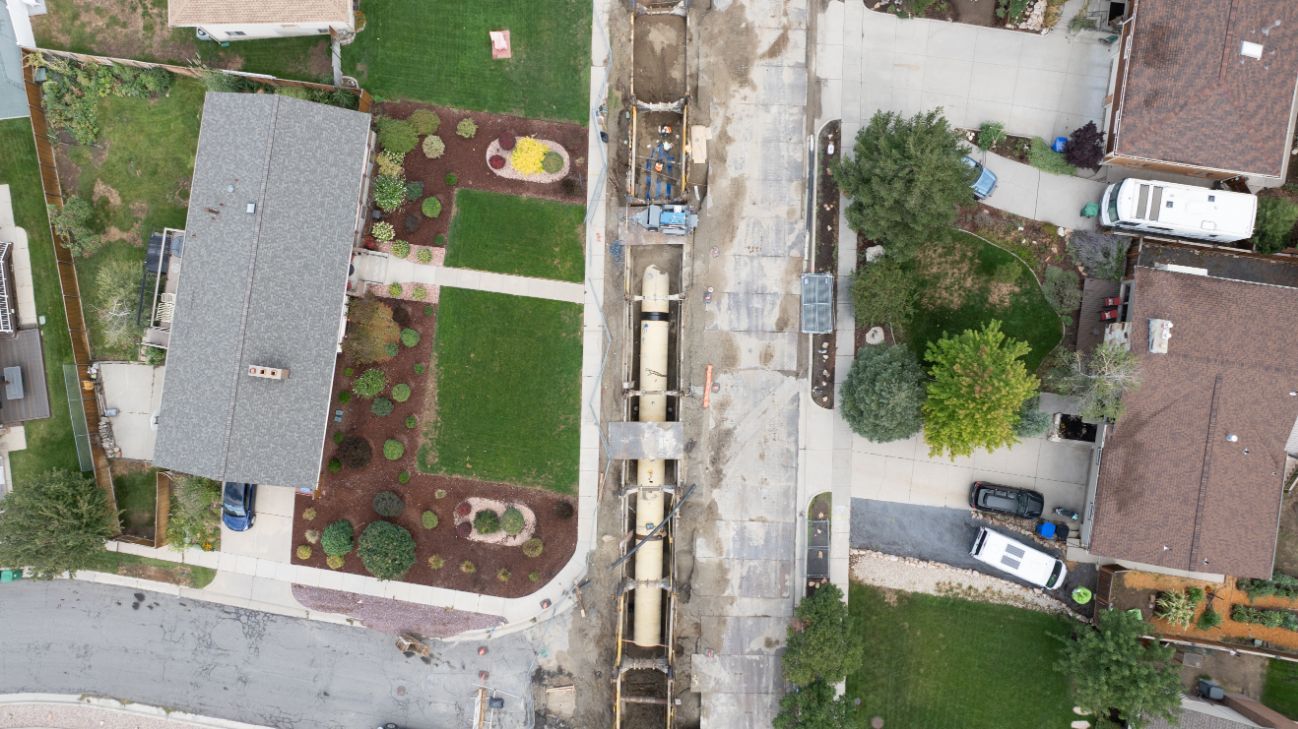
Beyond the tunnel, the new alignment will include more than one mile of 108-inch welded steel pipe running through Orem’s Orchard Park neighborhood and away from the current alignment’s active landslide complex. Construction teams installed a thrust block containing 850 CY of concrete to manage the 1.7 million pounds of water that will eventually be delivered. There, the 108-inch pipe will connect with the bell of the ball in terms of seismic resilience—600 feet of hazard-resilient ductile iron pipe (HRDIP). Elison and Lingwall explained how HRDIP, developed by Japan-based Kubota, is gasketed and designed to elongate and rotate during a seismic event to keep the aqueduct up and running.
Whether boring through a mountain or planning for capacity upgrades, Central Utah keeps water flowing via top-tier industry collaboration.
Jordan Valley
Project Name: Southwest Aqueduct Reach 1 & Reach 2
Location: South Salt Lake County
Cost: $18 million (SWA-1), $35 million (SWA-2)
Construction Timeline:
March 2018 - February 2020 (SWA-1) September 2025 - June 2027 (SWA-2)
Design & Engineering: Bowen Collins & Associates
General Contractor: COP Construction (SWA-1), Condie Construction (SWA-2)


Jordan Valley
Water has always been a concern for Utah legislators and residents, said Jacob Young, General Manager of the Jordan Valley Water Conservancy District (Jordan Valley).
“Now, it’s risen to number one.”
November 2025 revisions to the Utah code required cities with populations of over 10,000 residents to deliver a general plan that included water use by December 31, 2025. State leaders aren’t leaving municipalities marooned. Utah’s Division of Natural Resources “Growing Water Smart” program has helped city and county water and land-use planners collaborate through guided workshops to build a sustainable, resilient water future. When land and water use planning happen together, Young said, “I believe we will be able to continue to support communities and ecosystems from the same sources of water.”
Strategic planning has become more important than ever as development charges forward. Jordan Valley’s latest master plan finished in 2022, “and we felt that as soon as we finished it, some of our [master] plan was outdated,” said Young. The Point, Olympia, and other developments and annexations within their jurisdiction all released plans shortly after Jordan Valley’s master plan finished.
Jordan Valley may be further along in its development cycle than the other districts, but the area within its boundaries is far from finished. “It’s not necessarily the total demand,” said Young, “but where that demand is located.” As such, the district is focused on upgrading existing infrastructure to accommodate the roughly 800,000 users currently served and an additional 400,000 residents expected to receive their water from Jordan Valley over the next several decades.
“There are some cool projects going on, and there’s a massive wave coming,” Young said.
Hard to resist a water pun.
As Jordan Valley supplies South Valley growth and the rest of Salt Lake County, it is currently building the $20 million 118th South Tank Project in South Jordan. The 10-million-gallon tank was designed by Jacobs and is currently under construction, overseen by ProBuild Construction.
Another South Valley supplier project is the Southwest Aqueduct (SWA), a multiphase pipeline running parallel to the existing Jordan Aqueduct to provide redundancy and additional raw water supply capacity. At completion, SWA will span from the Jordan Valley Water Treatment Plant in Herriman north along 3200 West, eventually connecting with the 10200 South Pump Station and Reservoir. SWA Reach 1, the $18 million first phase, was designed by Bowen Collins & Associates and built by COP Construction. The $35 million SWA Reach 2 is under the same engineering and design stewardship, with Condie Construction leading ongoing construction efforts to extend the SWA from 13400 South to 11800 South.
Expansion on the Jordan Valley Water Treatment Plant is the big kahuna. The three-phase project will expand plant capacity from 180 million gallons per day (mgd) to an interim capacity of 200 mgd, followed by another expansion to its final 255 mgd capacity to meet future demand. The project includes full rebuilds of six original gravity filters, partial rebuilds of ten gravity filters, and new chemical feed systems across multiple project phases. The additional 75 mgd of new filtration/chemical capacity will treat 16,000 acre-feet of Central Utah Project Utah Lake System supplies procured from Central Utah.
Phase 1 was designed by Brown and Caldwell, built by Vancon Construction, and completed in 2023. Phases 2 (Hazen and Sawyer) and 3 (Corollo) have both been designed. While Gerber Construction is currently building Phase 3, with completion scheduled for April 2029, construction on Phase 2 is awaiting FEMA grant money, but Young noted that the grant application process has been suspended under the Trump administration.
Whether planning for hundreds of millions of dollars in capital outlay or utilizing social media to engage Jordan Valley water users in conservation efforts, Young and the Jordan Valley team identified a core imperative in their plans: “Establishing the community's conscious connection with water and removing the mystery and the unseen nature of water,” said Young. “There is a limit to the water resources available in the state. That means that development from here on out has to look differently than it has up to this point.”
Washington County
Project Name: Chief Toquer Reservoir
Location: Toquerville
Cost: $60 million
Construction Timeline: November 2023 - December 2026
Dam Design; Construction Management: RB&G Engineering
Foundation Work; Initial Dam Construction: Feller Enterprises
Dam Embankment: Harward & Rees
Pipeline Engineering: Bowen Collins & Associates, Alpha Engineering
Pipeline Construction: Harward & Rees, Whitaker Construction, WW Clyde

Washington County
Everyone in the industry knows Washington County is hot, and that’s just in development terms. Karry Rathje, Public Affairs Manager for Washington County Water Conservancy District (the district), said the organization isn’t sweating it out but is staying proactive—and comprehensive—in its approach to water stewardship.
The district currently delivers to approximately 215,000 residents and 10 million annual visitors who rely on water from the limited and variable Virgin River Basin. The basin’s available 10-year average water supply has decreased nearly 20% since the 1980s, while population in that same timeframe increased well over 350% and, according to the Kem C. Gardner Policy Institute, is expected to nearly double by 2065.
“We’re experiencing rapid growth with limited water resources,” said Rathje. “But the district has a proactive plan to ensure our communities have a safe, reliable water supply now and in the future.”
The plan includes additional water conservation, reuse, optimizing groundwater resources, developing remaining surface supplies, and converting available agricultural water to municipal use. The five-part plan will add about 40,000 acre feet of new supply at a $2 billion price tag.
Most of the water needed to meet future demand will come from the district’s Regional Reuse Purification System, which extends Washington County’s two-decade legacy of reusing water for crops and landscape irrigation. Future system expansions will provide a local, drought-proof water supply sufficient to serve approximately 40,000 homes, including purified water for potable reuse. Major components of the system will include three water reclamation facilities, an advanced water purification facility, four reservoirs, multiple pump stations, and more than 60 miles of pipeline when completed.
Conservation efforts in the district are worthy of gold stars. Washington County has achieved a 50% per capita reduction in water use since 2000 and has adopted Utah’s highest water-efficiency standards for new construction as development has increased. The district’s board approved a bump in impact fee rates, raising connection fees for single-family homes to $17,000 come March 2026, so new development pays for expanding infrastructure. The district has also adopted an excess water use surcharge to encourage accountability and reduce waste among high users. The district isn’t just wielding the stick. Dangling the carrot has helped the area lead the state in participation in the grass replacement program, accounting for 51% of the grass replaced statewide since 2023.
Zach Renstrom, the district’s General Manager, explained the reasoning behind these and other changes simply: “The cheap water has already been developed.”
Beyond the Regional Water Conservation Plan and Water Shortage Contingency Plan created in 2025, the district has leveraged its good relationships with municipal partners to further align development goals. The district recently approved a new policy to oversee future large commercial, industrial, and institutional water users—those using over 9 million gallons in larger cities, or 5 million gallons in the smaller cities. Oversight will come from a 16-member Administration Advisory Committee made up of the mayor and city manager for each of the district’s eight municipal customers. Approval for new projects at this threshold, like data centers, golf courses, and bottling plants, will require a thumbs-up from two-thirds of the committee.
“These eight cities share the same water supply,” said Renstrom. “This policy ensures a single community cannot approve a large water user without review and consensus of the broader community.”
As development unfolds, the district continues current projects like the $60 million Chief Toquer Reservoir, $22 million Confluence Park Pump Station and Pipeline, $180 million expansion of the Quail Creek Water Treatment Plant, and $5 million storage tanks at Sand Hollow Reservoir to beat the heat and ensure the district’s water stewardship remains top-notch.
Weber Basin
Project Name: Davis Aqueduct Reach 1
Location: Layton, South Weber
Cost: $81.4 million
Construction Timeline: Fall 2023 - Fall 2025
Design & Engineering: Brown and Caldwell
General Contractor: Whitaker Construction


Weber Basin
“I got it first, then it's mine, and I'm going to use it how I have historically.”
Those words from Jon Parry, Assistant General Manager for the Weber Basin Water Conservancy District (Weber Basin), exemplify a mindset for how water has historically been treated in Weber Basin and other districts since their creation, where water rights have gone to the first user through the prior appropriations doctrine.
Call it doctrine, policy, or culture—some or all of it needs to change for this finite resource to continue indefinitely accommodating a growing economy and maintain a certain quality of life. The shift, said Parry, needs to be “where water is serving its highest and best use.”
Parry, P.E. is an engineer by trade and educator by role, and said Weber Basin’s efforts have worked within the existing system to prioritize what’s in the best interest of the community as a whole by facilitating workshops and getting their users to buy in to the district’s outlook, namely: “That water is a regional resource and not an individual resource, and come up with goals and programs that help us accomplish all that we can.”
So far, the marketing is working, and mindsets are changing. The district will complete its plan to meter all secondary water system connections by 2026. By 2030, Weber Basin will begin charging for secondary water use—One Water, after all. Charging for what was once free, Parry said, will take some time to get everyone on board, but he’s confident that the goodwill between Weber Basin and its customers will continue.
“We've had a lot of opportunities to engage with our customer base, educate them about what's going on, and what to expect moving forward,” said Parry, praising “[the] great collaborative process of working with the Weber Basin water customers on plant materials, landscapes, and projects that will deliver a robust, green community that keeps water use minimal.”
Collaboration continues on the business-to-business front as Weber Basin strengthens the great partnerships it has forged with the A/E/C industry to maximize every water droplet. These relationships are more important than ever as Weber Basin looks to modernize and expand its capital infrastructure.
“We’re reaching [the] end of life expectancies for a lot of the infrastructure put in 75 years ago,” said Parry. Massive pipelines, aqueducts, treatment plants, irrigation reservoirs, and more are long past senior status, “and we’ve got them slated to have some evaluations done on them, with a lot of [money] anticipated [to] be needed to do those replacement projects and make sure that they’re able to operate for another 100 years.”
Weber Basin has $1.5 billion scheduled for design, engineering, and construction over the next 10 years, with much of that money prioritizing resiliency of its water infrastructure, such as the award-winning Davis Aqueduct Parallel Pipeline, which began over a decade ago. Planning by Weber Basin, design by Brown and Caldwell, and construction led by Whitaker Construction helped deliver the first 2.2 miles of the 25 planned miles of pipeline running parallel to the existing Davis Aqueduct. Parry said those efforts, “give us a little bit better sleep at night as we think about the seismic conditions that we operate in.” As they wrap up the final pieces of this first phase to ready the system for irrigation season, Parry said to expect an additional five miles of parallel pipeline to go in over the next 10 years, along with many more projects to come.
“There is not going to be a shortage of opportunities to engage in meaningful work that really does affect the quality of life for every single resident here in the state of Utah,” said Parry of how leveraging A/E/C expertise is extending the goodwill to the consumer side as well. “We’ve seen amazing benefits to the public as we've been able to have those discussions and be able to advocate for water conservation.”
Education, collaboration, and innovation from the A/E/C community will be most welcome to help Weber Basin meet demand and achieve efficiencies. After all, Parry laughed, “You’re not going to get away from using water.”
Water use, like the Colorado River, continues to flow. Whether that remains so won’t be a decision left solely to those renegotiating the Colorado River Compact. Instead, it will come from compounding daily decisions made by conservancy districts, government leaders at every level, industry partners, and anyone who turns on the tap. Compromise and collaboration are the sobering realities needed to ensure our One Water continues to flow; the alternative is too dry.