Ghosts in the Night

Construction and design teams combined to create vehicle-friendly joints for the SR-26 Bridge in Riverdale, completing the work in the stealth of the night.
By Taylor Larsen

No news is good news on many a roadway project. 

With no hotline calls coming to the public engagement team led by Kimley-Horn, construction looked to be going off without a hitch from a public perception side, and the public was right.

Like ghosts in the night, the Granite Construction team managed by Zach Schweinsberg, Project Manager, completed the SR-26 bridge joint repairs, adding new life to the confluence of roadways in Riverdale.

Mind the Gap

The SR-26 bridge, originally built in 2006, was working well except for two critical junctures—the expansion joints between the bridge deck and approach slab.

The gap from the expansion joint only widened at the surface—nearly eight inches, according to the project team—but created ongoing issues for the traveling public. Repairs in 2013 and consistent maintenance were effective bandaids to keep the joints safe and smooth, but not permanent solutions for such essential infrastructure.

At 8–10 inches wide, the bridge would need more steel, both physical and metaphorical, to endure the rigors of daily travel from an average of 52,000 vehicles. The project team wasn’t interested in chiseling away at the old to find a new solution, said Travis Jones of UDOT’s Structures Division. 

Instead, “We hit [the problem] with a sledgehammer.” 

They used the full force of expertise, high-end materials, and a best-in-class project team to close the gap for good.

Fill the Gap

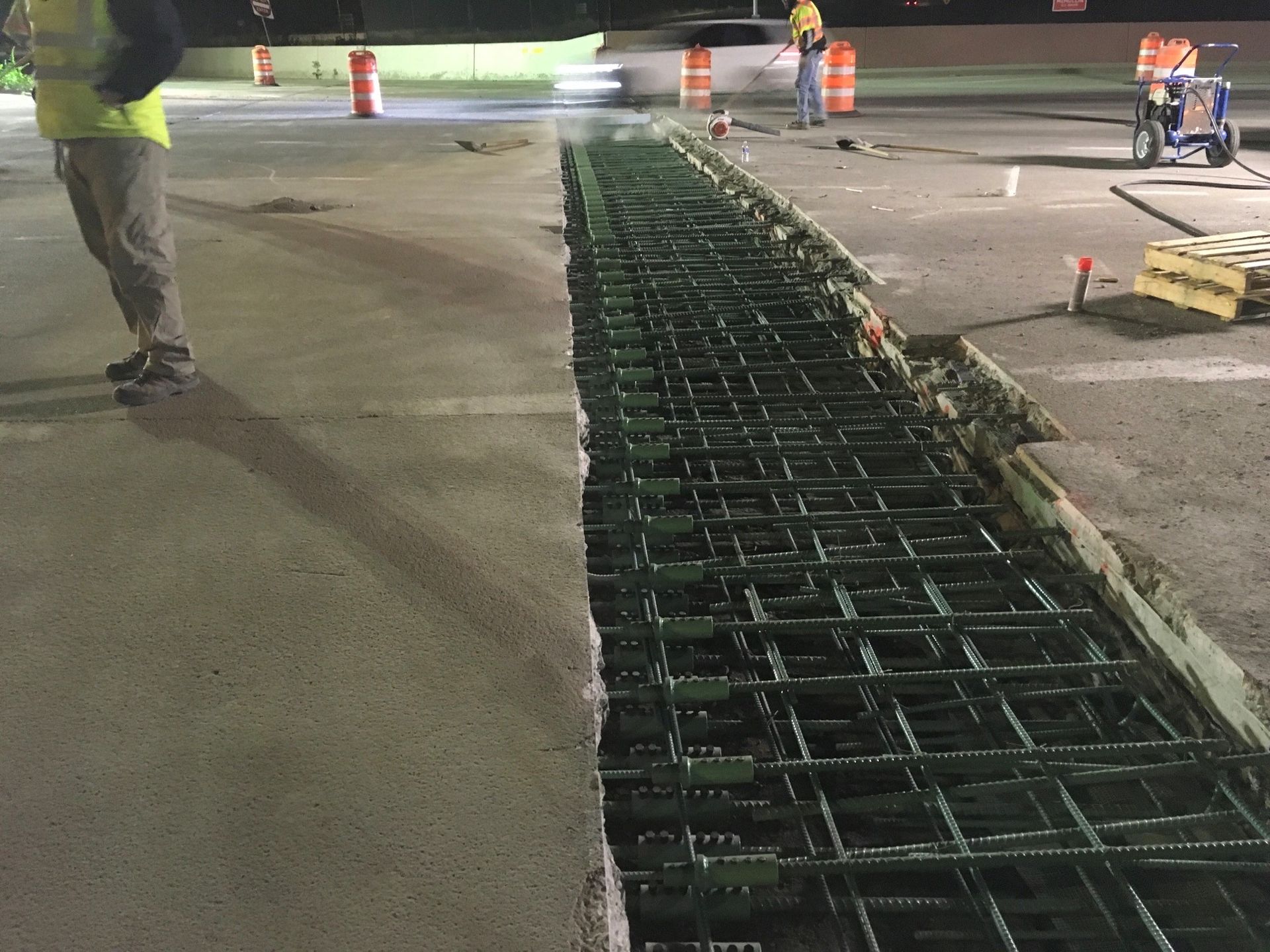
Closing the existing joints would require a bevy of materials: rebar would nearly double in size from the previous joints, giving the joint closure the needed steel to remain closed for the life of the bridge.

It led to an early complication, according to Guy Evans, Resident Engineer for designers and owner representatives HW Lochner. “We couldn’t detour people during the day,” he said. “We had to have traffic flowing in the morning” in time for everyone’s daily commute.

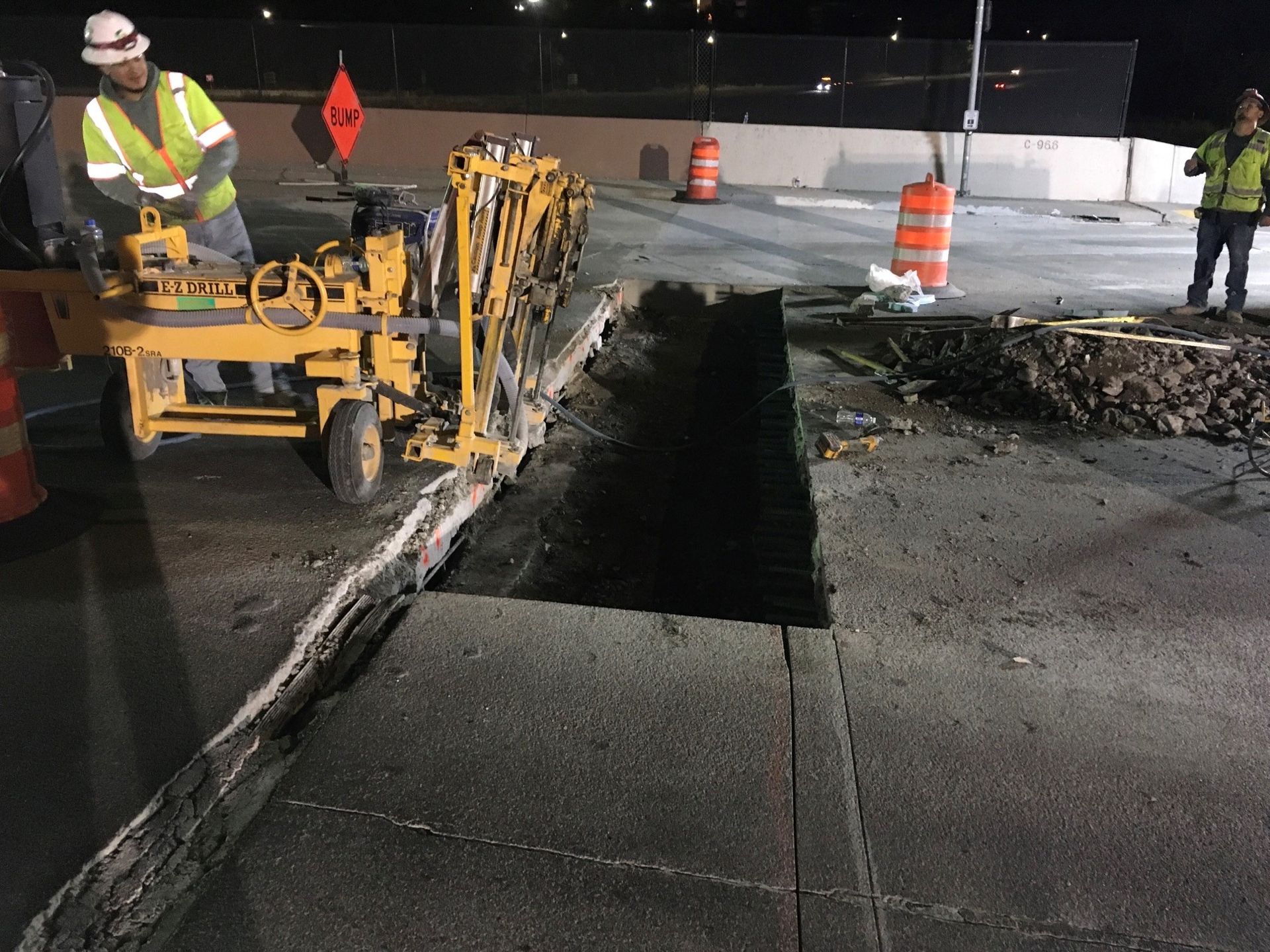
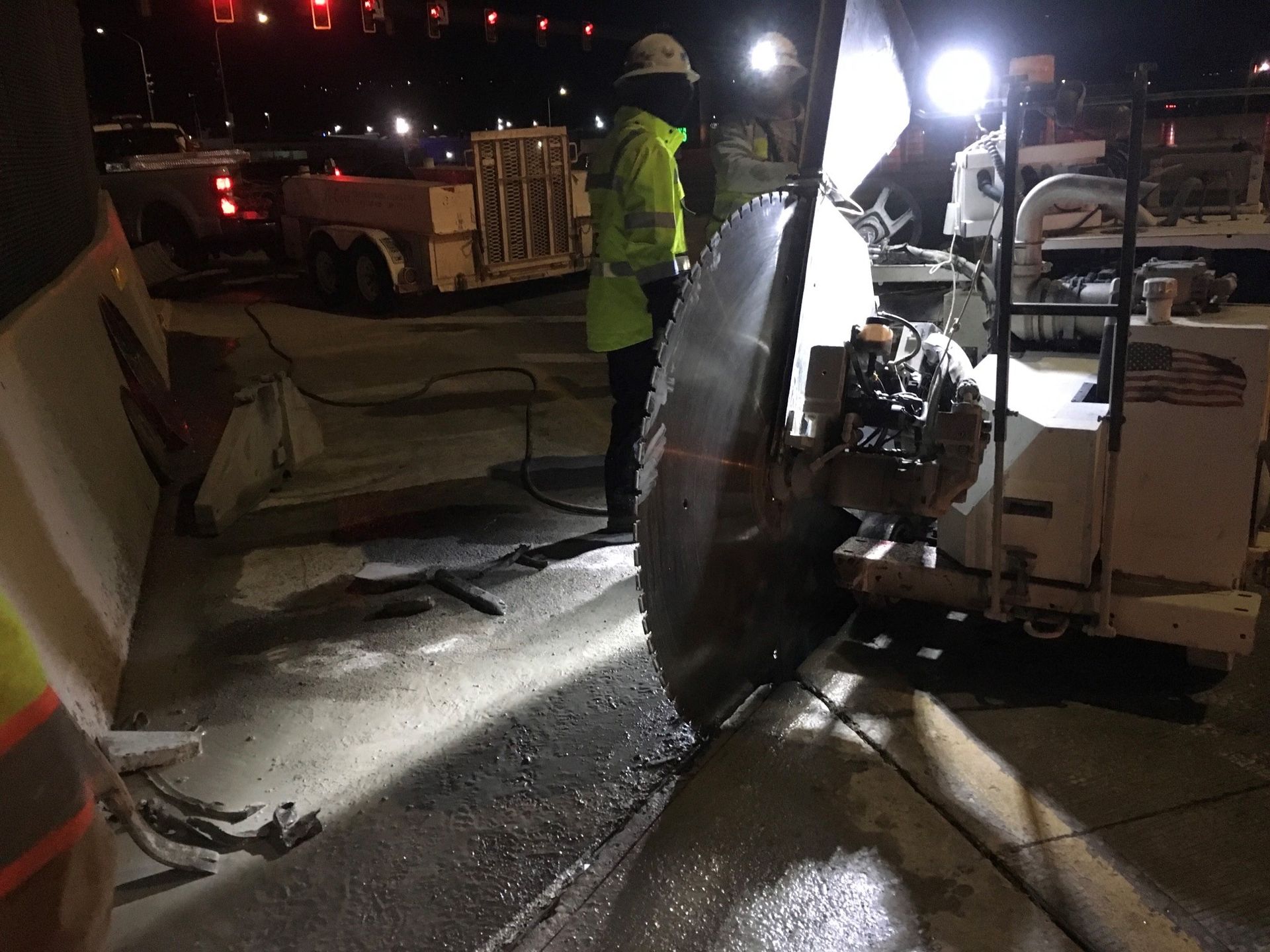
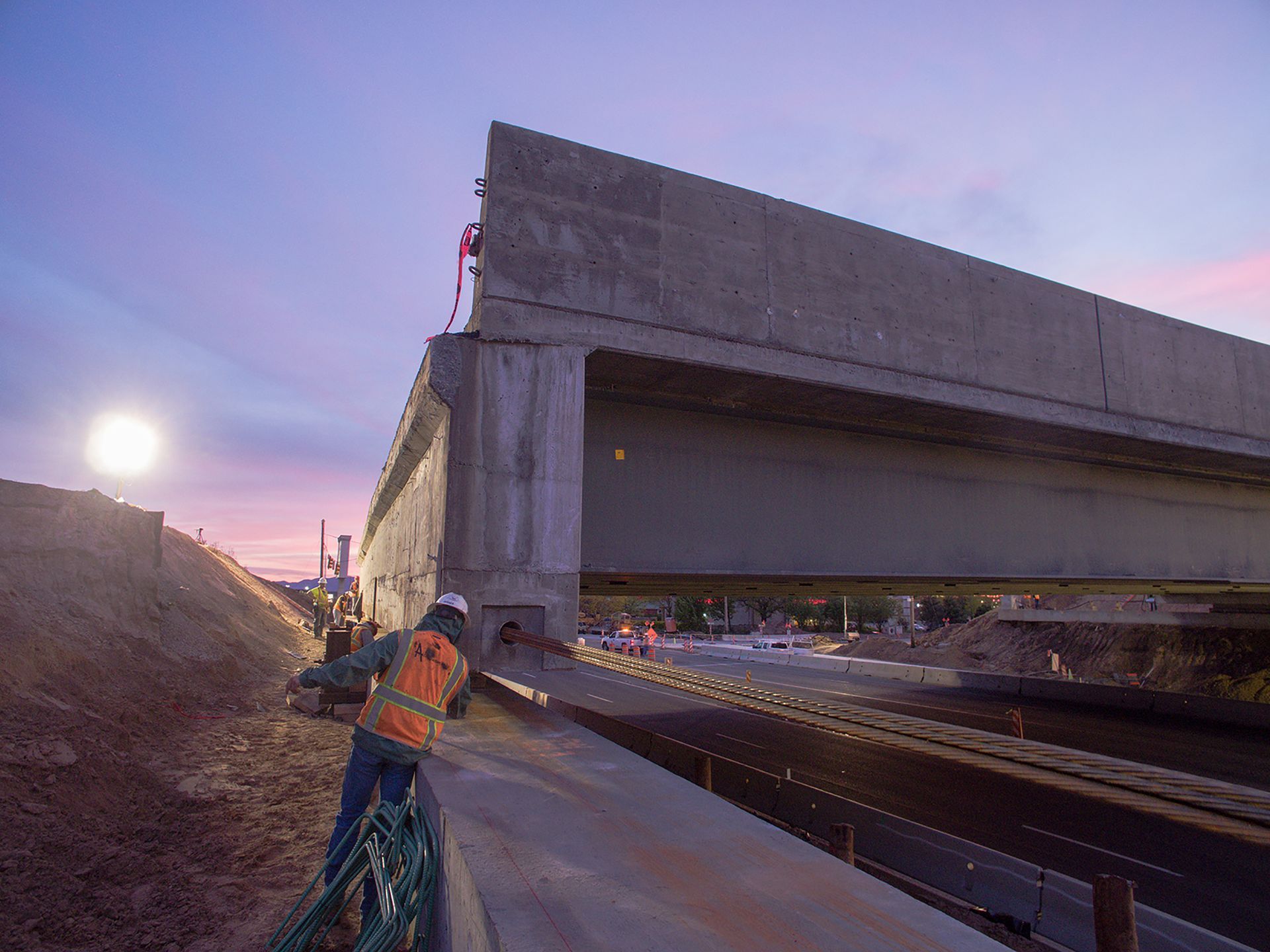
Speed, stealth, and precision were the themes for the project, according to the various team members. Schweinsberg said the team streamlined the process by pre–saw cutting the removal phase lines in the concrete to ready it for demolition work on the succeeding night. This concrete precutting halved the projected construction time by allowing the crews to work on both joints in a single night shift. 

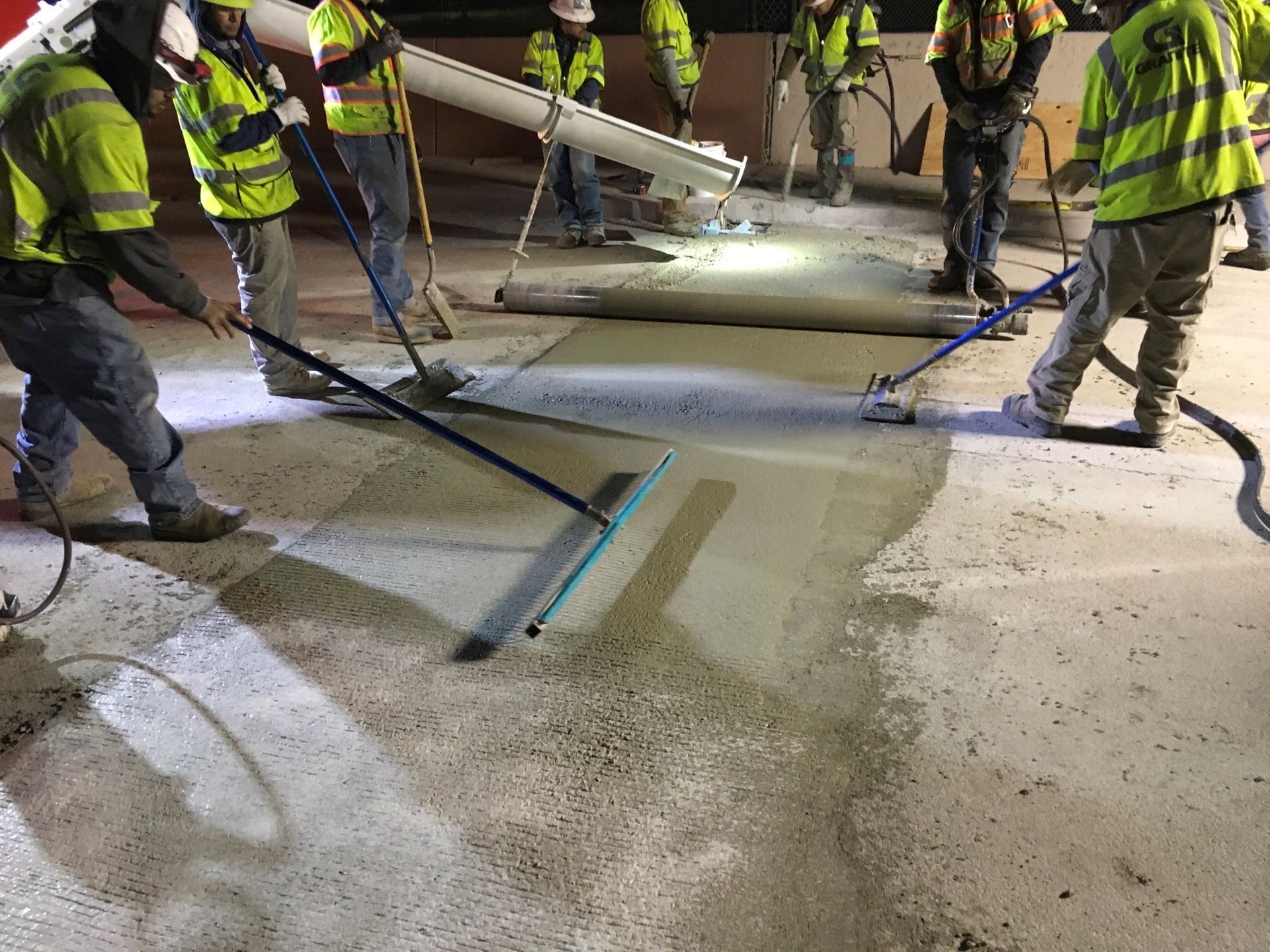
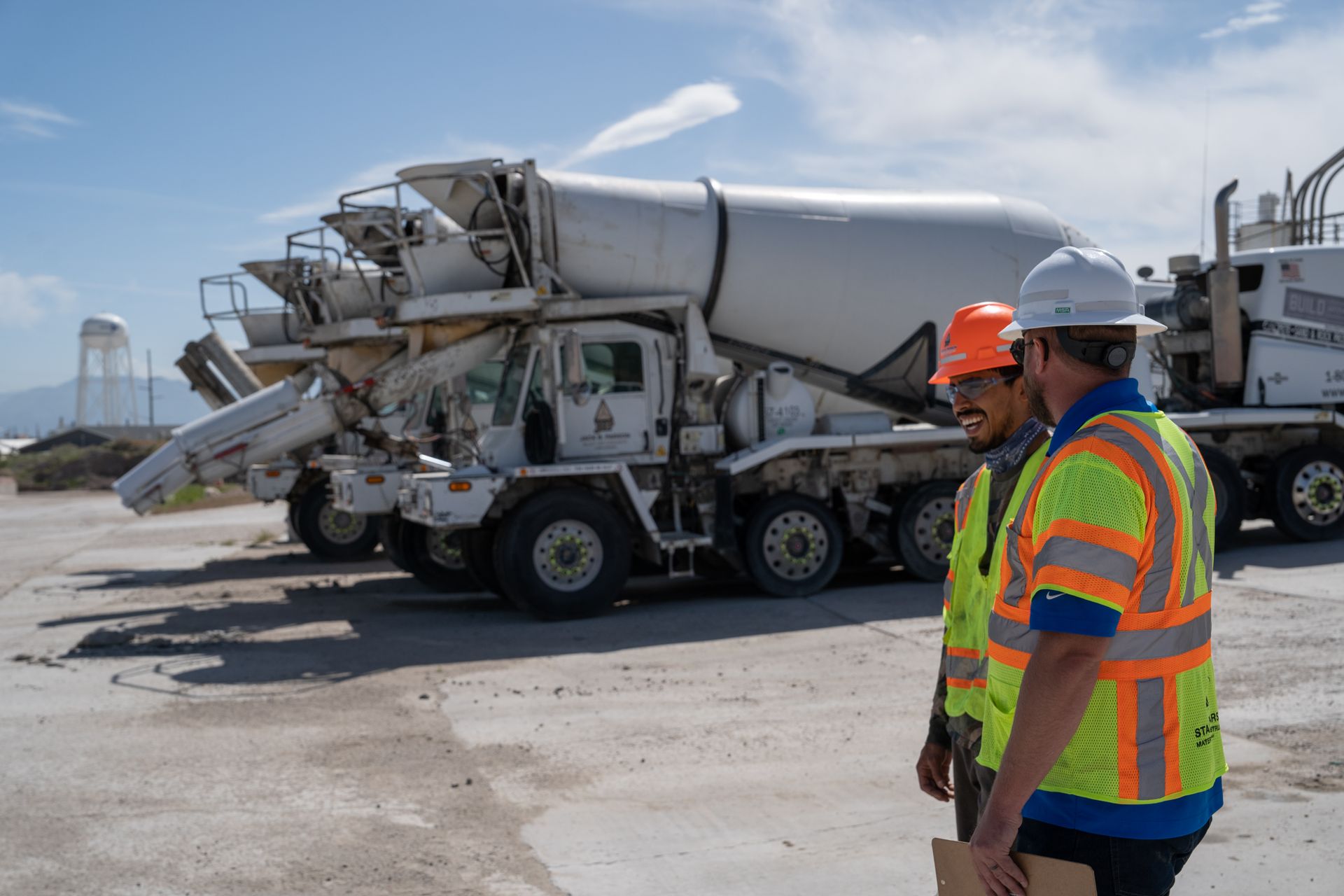
To deal with the traffic volume and limited construction window, the construction team bought in 73 CY of Rapid Setting Hydraulic Cement Concrete to work its magic. The concrete, Evans said, came in a volumetric truck that mixes the specialized concrete to exact specifications seconds before placement into the joint.

“You can walk on it in an hour and drive a semi over it two hours later,” said Evans of the high-strength, quick-curing concrete. It was the perfect product to seal in steel and resiliency—and seal up the joint.


Matt Rink, also from UDOT’s Structures Division, explained that each night, the project team would install traffic control, jackhammer and saw cut to remove the existing concrete and rebar, then put the new rebar back (totaling 21,821 lbs of rebar), pour the rapid-set concrete, remove traffic control, and effectively disappear—all before the clock struck 6 A.M.

  • Slide title

    Write your caption here
    Button
  • Slide title

    Write your caption here
    Button
  • Slide title

    Write your caption here
    Button
  • Slide title

    Write your caption here
    Button
  • Slide title

    Write your caption here
    Button
  • Slide title

    Write your caption here
    Button
  • Slide title

    Write your caption here
    Button

New Joint


As one joint closed, another opened. The combination of HW Lochner’s Evans and the UDOT team led by Jones and Rink designed an entirely new joint to tie the bridge deck to the approach slab, relocating the new compression joint to the end of the approach slab and concrete roadway. 


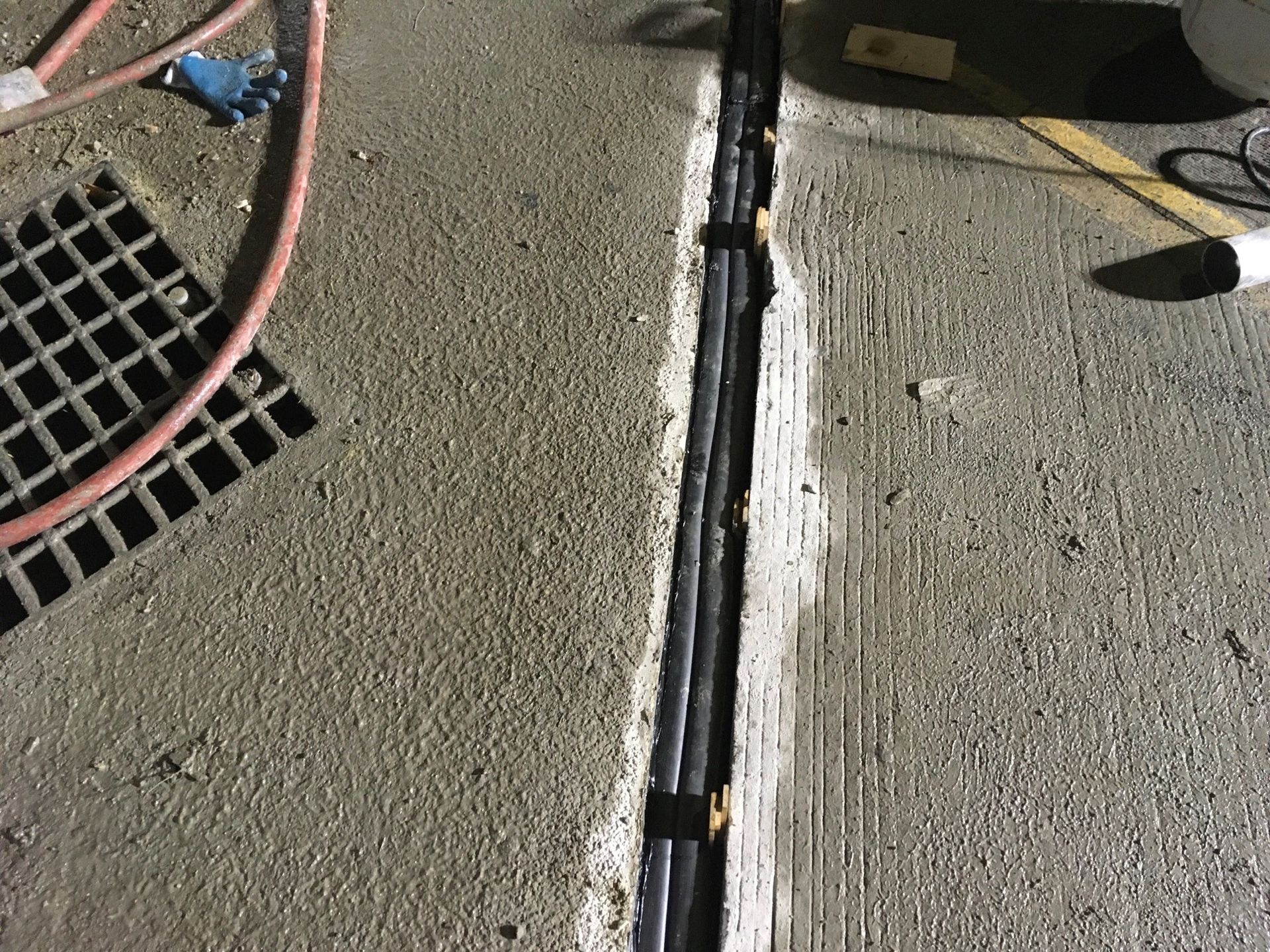
Just 25 feet away, saw cuts and jackhammers returned to provide a rhythm to the night. Crews cut away three inches of concrete to place the new EMSEAL compression joints, highly durable, rubber-topped foam that bonds well to concrete and expands and contracts with any thermal expansion or shifting from the two sides. Instead of expansion occurring between the approach slab and bridge, it is now happening between the approach slab and concrete roadway, said Schweinsberg.


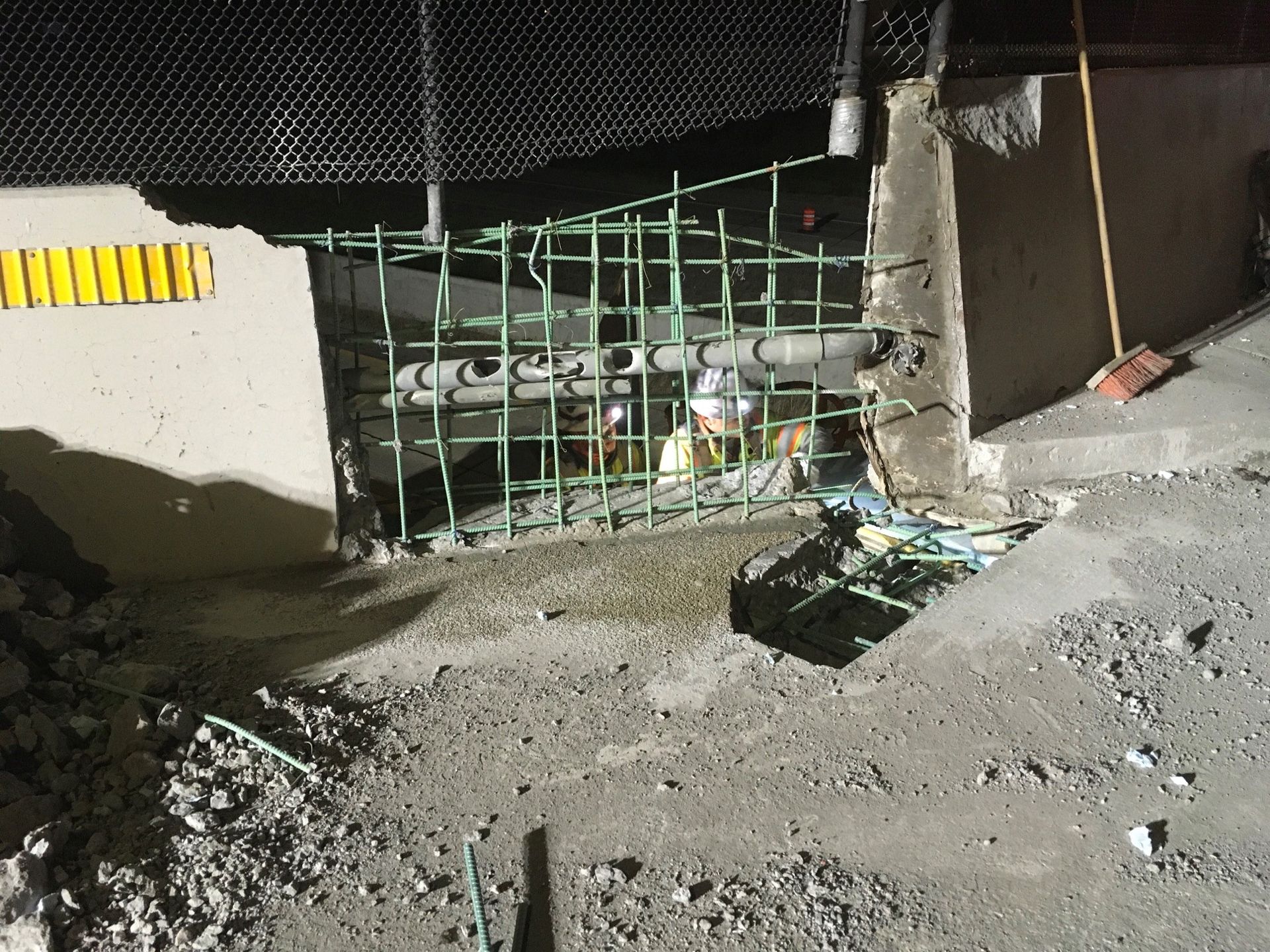
Crews also removed four feet of rebar from the approach slab as they worked to close the old expansion joint. Schweinsberg said that, because of the tight working areas at the bridge, it was nearly impossible to obtain enough lap between the existing and new rebar. 


“By using mechanical couplers, we were able to attach the new no. 8 and no. 9 bars while only exposing six inches, as opposed to 48 inches for required lap length,” he said in regards to the special order transition couplers
that made the tie-in possible. The couplers also reduced the removal footprint and and made traffic maintenance more feasible. 


On this new joint portion, too, designers had nothing but praise for the construction team and their work. Evans said, “Granite [Construction] really shined on this. Their production rates were double what we anticipated.”


Both joints were replaced across the entire roadway in just 13 nights, while parapet repair and more constituted the other six nights crews spent on the project so far.


The experience between the trade partners, Rink said, made this a sequencing dream. “It was the A-Team all the way across the board.”


With old joints closed and new joints created, the project is just a few more workdays away from full completion. Once the weather warms up, the Granite Construction crews return and complete the final phase of their work. Like a special forces team placed into a hot spot, they will add in the thin-bonded polymer overlay and concrete coating to get the bridge back to its transit-supporting best.


SR-26 Bridge Joint Repairs

Location: Riverdale, Weber County
Cost:
$967,769

Project Team

Owner: UDOT
Owner
s Rep: HW Lochner

Public Involvement: Kimley-Horn
Prime/General Contractor:
Granite Construction
Subconsultants:
AAA Barricade, American Pavement Markings, A-Core, Forte, Western Paving Inc, Comers Concrete, Protech and B Jackson



By Brad Fullmer October 15, 2025
When Lehi-based Reef Capital Partners (Reef) initially announced plans in 2018 to build a sprawling, estimated $2 billion mega-resort with a championship-caliber golf course on 600 acres covering parts of Ivins and Santa Clara—small towns with just over 15,000 combined residents at the time—it was difficult to fathom what a project of that magnitude might look like. Fast forward seven years, and Black Desert Resort is indeed a shining oasis amidst Southern Utah's famed red rock cliffs, sitting atop an ancient lava field, with buildings strategically carved into the land to produce a resort unlike anything else. "This is the biggest project we've ever done—we feel really good where we are," said Brett Boren, President of Real Estate for Reef, acknowledging the general completion of the $290 million, 806,000-SF resort center, along with significant ongoing work—including a 1,298-stall parking garage, condominiums, and a private water park. As of September, all aspects of the main resort center were open and fully complete, with the hotel celebrating its first official year in business after partially opening in September 2024 as it hosted the inaugural PGA Black Desert Championship October 10-13. The second installment of the tournament—now dubbed the Bank of Utah Championship—is slated for October 23-26, with a third tournament signed for 2026.
By UC&D October 1, 2025
In 2005, Calder Richards Consulting Engineers formed after the merger of two smaller structural consulting firms who, interestingly enough, both started in 1986. Calder Richards has provided a steady structural support for Utah’s built environment ever since. As the firm celebrates its 20th anniversary, UC+D spoke with Managing Principals Shaun Packer and Nolan Balls to look back over the company’s history and celebrate what has helped their firm stand out to deliver solid projects in Utah and beyond. Their responses were edited for clarity and brevity. UC+D: What have been some catalytic moments for Calder Richards since that initial merger? SP: Winning the Talking Stick Resort in Scottsdale, Arizona is the first one. The big reason for the merger between Richards Consulting Group and Calder Consulting was to build a large enough company to go after bigger projects like that.” NB: That was my first project when I was hired straight out of college. We helped design the 17-story hotel and casino, a conference center, as well as parking structures, a central mechanical building, and a pool building. Talking Stick helped get us through the downturn a few years later. UC+D: What have been your key market sectors you all have targeted over the last 20 years? NB: We were breaking into K-12 along the Wasatch Front soon after the Talking Stick Resort and it’s been our bread and butter since then. SP: Absolutely, but I credit our firm for always adapting to the current environment. We’ve been fortunate to do so much K-12, but we used to do a lot of office work, and now we are working on conversions like the Ebay Headquarters to CTE/Innovation Center for Canyons School District as the market has shifted away from commercial office. UC+D: Schools have certainly evolved over the last 20 years, how has your work as structural engineers evolved? SP: We are seeing more creative design on the architectural side, certainly. We see many more two-story designs; more windows and daylighting. But we’re utilizing more powerful tools and continually building our understanding of the structural materials that are in use more than ever—tilt-up concrete, steel columns and beams, especially—to be the architect’s trusted partner. NB: Schools have definitely changed, and we’ve had better experience in helping projects move forward successfully when we are involved earlier in the design process. As we got involved early on in West High School’s schematic design, we were able to provide structural solutions and options to accommodate the architects’ design intent. UC+D: How has company growth changed Calder Richards? SP: It’s certainly changed the number of people in our office. We started with around 10 people when we merged, and today we have 27. But we often say that we don’t want to grow just to grow—we want to grow sustainably. We don’t lay people off when works slows down, and we have an expectation that sometimes there will be overtime work, and other times you may be waiting for our next project to begin.

By By Taylor Larsen October 1, 2025
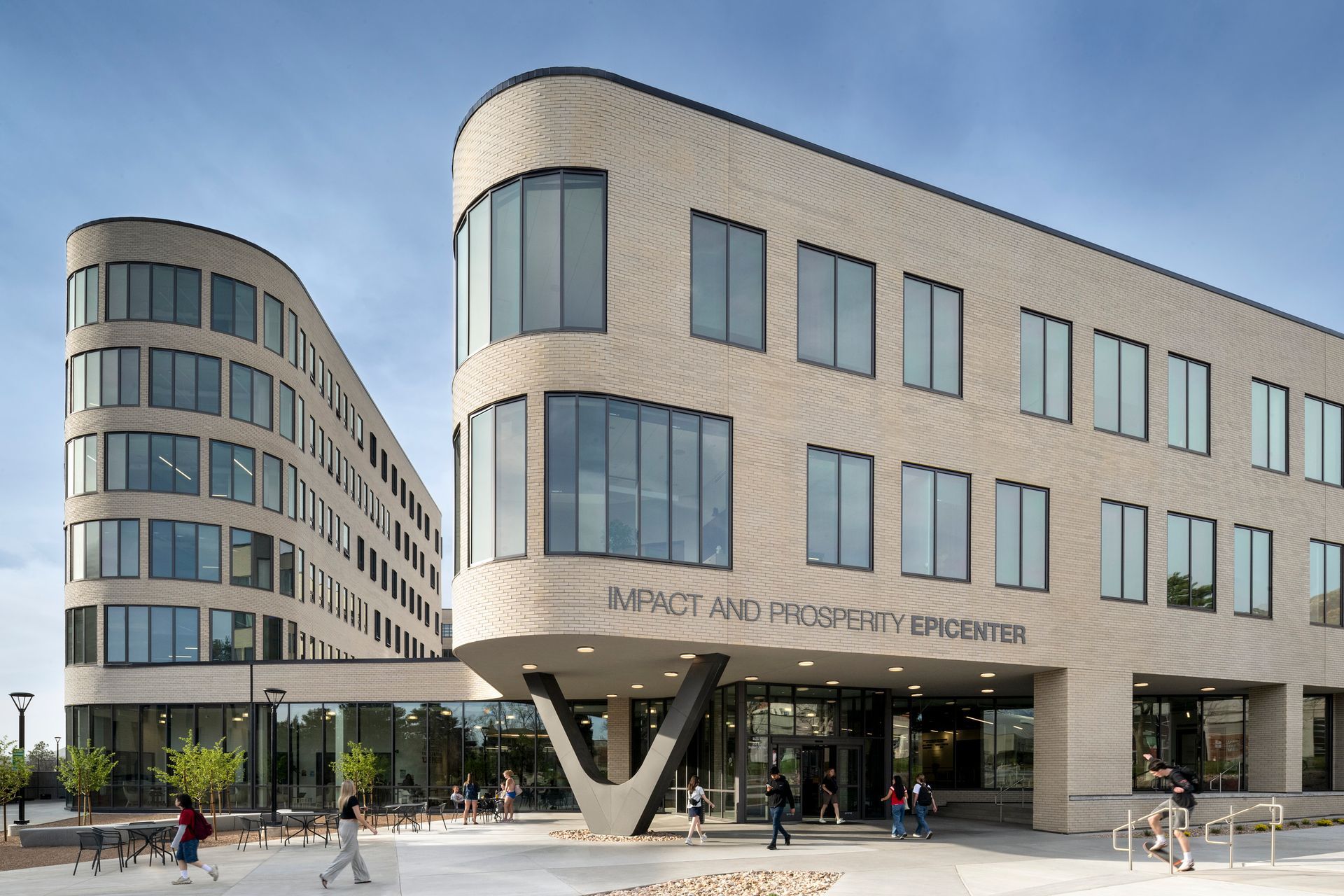
Nested in the middle of the University of Utah (U of U) campus sits the aptly-named Impact & Prosperity Epicenter, the second living learning community (LLC) project designed on campus by Los Angeles-based Yazdani Studio of CannonDesign. After nearly a decade since their first LLC project, the award-winning Lassonde Studios (UC+D’s 2016 Most Outstanding Public Building over $10 million), Mehrdad Yazdani, the design firm’s Principal and Studio Director, said their work on a sequel was an exciting prospect for the firm, and enlisted Salt Lake-based MHTN Architects and Okland Construction to serve as the respective local architect and general contractor. Today, the Epicenter serves as a striking piece of architecture and construction, one whose curvilinear shape asks users and visitors plenty of questions. But moving from idea to execution has been a work in progress. One query from Yazdani stood out as it relates to students and the built environment, and helped begin the journey to create the Epicenter: “How does your living environment as a student impact your success as a student and as a changemaker?” A Project for an Evolving Campus Katie Macc, CEO of the Sorenson Impact Institute, said LLCs like the Epicenter and Lassonde Studios next door have been massive steps forward in advancing entrepreneurship and social impact. But both play a major role in creating “college town magic”—a phrase coined by University President Taylor Randall that invokes a vibrant campus where students can find community and have one-of-a-kind experiences. With more on-campus student housing in the works, the state’s flagship university is hoping to shed the “commuter school” label and deliver a level of desirability that matches the resources students commit to higher education. “There is some soul searching going on across university campuses,” said Macc of the challenge at hand. “We have to be convincing that going to college matters.” She said overall university enrollments across the nation are decreasing as students grapple with tuition costs, COVID and its isolating aftershocks, and a different perspective on higher education. Universities are no longer a place where students come to learn what they couldn’t learn elsewhere—remote learning and the internet have opened a fissure in that idea that will never close. Instead of that educational transaction, being at a university must include building community and creating in-person experiences only available on campus. Macc said that the Epicenter helps steer the campus experience toward the future, with design goals to create a base of operations for two changemaking organizations and a living and learning home for 778 students. The three-story commercial portion of the building, known as the “Changemaker Pavilion”, includes office space for The Center for Business, Health, and Prosperity (second floor) and the Sorenson Impact Institute (third floor). While each organization has a different focus, both are firmly invested in helping students access and create the resources needed to change the world. Each entity works hand-in-hand as owners of the Epicenter to host events and “create a full spectrum of ways for students to get involved,” said Chad Salvadore, Chief Financial Officer for the Sorenson Impact Institute. “We’re dialing in the programming to energize the student body,” said Salvadore of the work done at the Epicenter. With over 60 majors represented among the 778 students who live there, he said that the diversity of students is less a reflection of their chosen major and more a desire to reside in a space built for students to work their entrepreneurial muscles. “Living here is a mindset—you can engage across many different paths you choose.”
By Brad Fullmer October 1, 2025
Front view of the bleachers, press box, and suites. (photos courtesy SIRQ Construction)
By Brad Fullmer October 1, 2025
Over the course of its 40-year history in Utah, WSP's Salt Lake office—originally founded as Parsons Brinckerhoff in 1985—has morphed from primarily a transportation design firm to one that successfully operates in multiple civil engineering markets. The results of WSP's transformation the past decade into a more diverse outfit speak for themselves, with the 128-person Salt Lake office (with locations in Cottonwood Heights and South Jordan) posting three consecutive years of revenues over $50 million, including a record $70.1 million in 2023, and a robust $59.9 million in 2024—good for the No. 2 ranking in UC+D's 2025 Top Utah Engineering Firms rankings.
By Taylor Larsen October 1, 2025
Lucio Gallegos vividly remembers the workforce development meetings he attended during his time at Ogden-Weber Tech. These career and technical education (CTE) discussions consistently focused on one thing: young people were not entering construction, and the industry needed a new approach to attract them. Gallegos recalled one member of the workforce development team, a training director with a prominent general contractor, saying, “We have been trying this for over 10 years, screw it, we’re just gonna hire them.” The Long Road Those conversations occurred nearly 10 years ago, and workforce development concerns continue to permeate the industry. The National Center for Construction Education & Research estimates that 41% of the construction workforce will retire by 2031, leading to potential gaps in skill and safety and decreases in productivity and project quality. While stakeholders have aligned on the overall goal of providing students a foundation for future success through career development, the means to achieve the ends were seemingly at odds. High schools, trade schools, colleges, and private industry took different paths to achieve their goals, with some moving in opposite directions. “I’m gonna be honest with you,” Gallegos recalled one school administrator saying, “If I promote what you’re telling me to get them over to the tech college, I lose head count. And then I lose teachers. I can’t have a school without teachers.” Jobs that took away student learning experiences, according to federal guidelines and child labor laws, made the idea a non-starter. However, after years of lobbying the Utah Legislature for a compromise between industry and education, H.B. 055, passed in 2023, provided a catalytic change in how younger people can engage with construction and other industries. High school students could participate if they were involved in a school-sponsored work experience and career exploration program. Private industry finally had the compromise it wanted. It was time to act. Big-D Charts New Path Gallegos, now the Workforce Development Manager from Big-D, joined the company in 2023 with the express purpose of creating a program that fit within the new guidelines. Gallegos said he sees career development through the lens of the immigrant experience, one he knows personally as a Mexican immigrant with a father who worked in commercial construction. “I was 9 years old and busting pins out of concrete forms with a hammer that was as big as I was,” he laughed. “I’ve got the cliché immigrant story.” That story has a theme familiar to many immigrant families, he said, one where parents say, “I want my kids not to have to work as hard as I do. I want them in school.” Add to that, it’s a law—children must attend school. Gallegos was unfazed by those obstacles. As he began planning how Big-D’s internship program would operate, he knew that engagement had to start at the elementary school level and build on personal relationships between private industry, school administrators, students, and their families to succeed. “We want to be the solution, not the obstacle to get into this industry,” said Gallegos. So Big-D removed the barriers. Students can still attend school, work towards graduation, and be available in the afternoon for sports, extracurricular activities, and the high school experience. But working was another significant part of the immigrant experience, Gallegos said, and internships needed to be paid to alleviate the family concerns. “We asked what we would pay somebody fresh out of high school who worked at Big-D,” Gallegos said. Interns have earned those same wages ever since.
By Brad Fullmer October 1, 2025
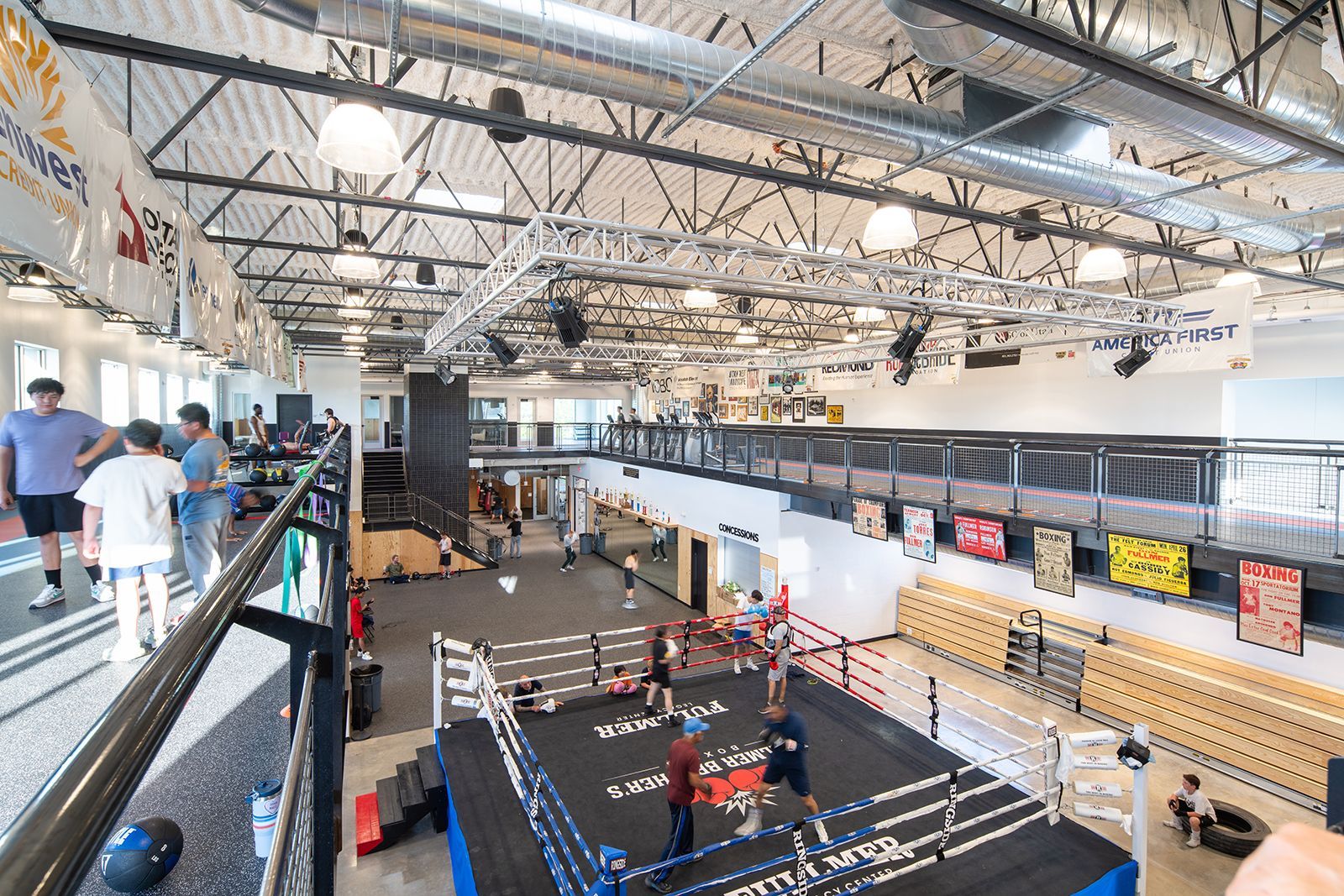
On January 2, 1957, Gene Fullmer, a scrappy, underdog fighter from West Jordan stunned the boxing world with a 15-round unanimous decision over the legendary Sugar Ray Robinson at New York’s fabled Madison Square Garden. Fullmer captured the world middleweight championship and established himself as one of the best pound-for-pound boxers during the late 50s and early 60s. Since then, the Fullmer name has been synonymous with boxing in Utah, with brothers Gene, Jay, and Don establishing the Fullmer Brothers Boxing Gym in 1978, and offering free boxing instruction and life mentoring to thousands of youths—carrying on a tradition they learned from their trainer, Marv Jenson. Their legacy of community giving will live on in the new Fullmer Legacy Center in South Jordan, a 16,500-SF facility that will serve as a permanent home to the boxing gym—after years of bouncing around to various temporary facilities—along with a museum, snack bar, and gift shop. “The Fullmers are the first family of boxing in the state of Utah—that’s well understood,” said Dave Butterfield, a founding board member of the Fullmer Legacy Foundation. Butterfield served as Chairman of the Board from June 2016 to early 2025 and was influential in helping raise money—nearly $6 million via donations to date, which includes $2 million from the Utah Legislature. Project Driven by Vision to Find a Permanent Home for Fullmer Brothers Gym It was Jay Fullmer who led the charge to teach boxing in the community. By 1978, the Fullmer Brothers Boxing Gym had formally opened at the Butterfield farm chicken coop in South Jordan, recalled Larry Fullmer, Don’s oldest son and the man who spearheaded the efforts for the Fullmer Legacy Center. From there, Larry said the facility moved to Riverton Elementary, an old church house in West Jordan, a sugar factory, a former fire station, and the Salt Lake County Equestrian Park in South Jordan, where it had resided since 2011. When they got word that Salt Lake County planned to transfer ownership of the park to Utah State University, Fullmer knew they needed to find a long-term home for the boxing gym. Fullmer met with Butterfield and Robert Behunin—who at the time was a Vice President with Utah State University—in 2016 and told them he just wanted a “tin shed of our own” for boxing. Behunin countered by saying, “If you want people to donate money, you need something better than a tin shed!” They quickly formed the Fullmer Legacy Foundation (FLF), and by 2018, the wheels were in motion on a building. Doc Murdock, a long-time trainer at the gym, connected Larry with his former roommate at Brigham Young University, Vern Latham, who is a Principal at Salt Lake-based VCBO Architecture. VCBO offered pro-bono services initially while helping FLF put together an RFP, while North Salt-based Gramoll Construction provided value engineering and other services in an effort to get the project launched. Larry expressed sheer gratitude for the contributions of both firms in helping make the project a reality, especially for many generous donations from various foundations and individuals. “[VCBO] believed in us early on and did our first phase of planning at no charge—they have been amazing and so professional to work with,” said Larry. “Gramoll helped us get the budget done as tight as it could be. This project had the absolute tightest budget. We met weekly with architects and the general contractor to see the progress—I’ve never seen such an amazing process. Construction started in November ’23, and every time I would come to the jobsite in the first six months, I’d get emotional.” “We leaned on our relationships with contractors for flooring, ceiling, tiles, donated furniture and got deep discounts and a lot of in-kind donations,” said Phil Haderlie, Principal-in-Charge for VCBO. “To me, the story of this project is the grassroots effort of people seeing the value—this is something that came from their heart. It will have a long-lasting impact on the community.”
By Brad Fullmer October 1, 2025
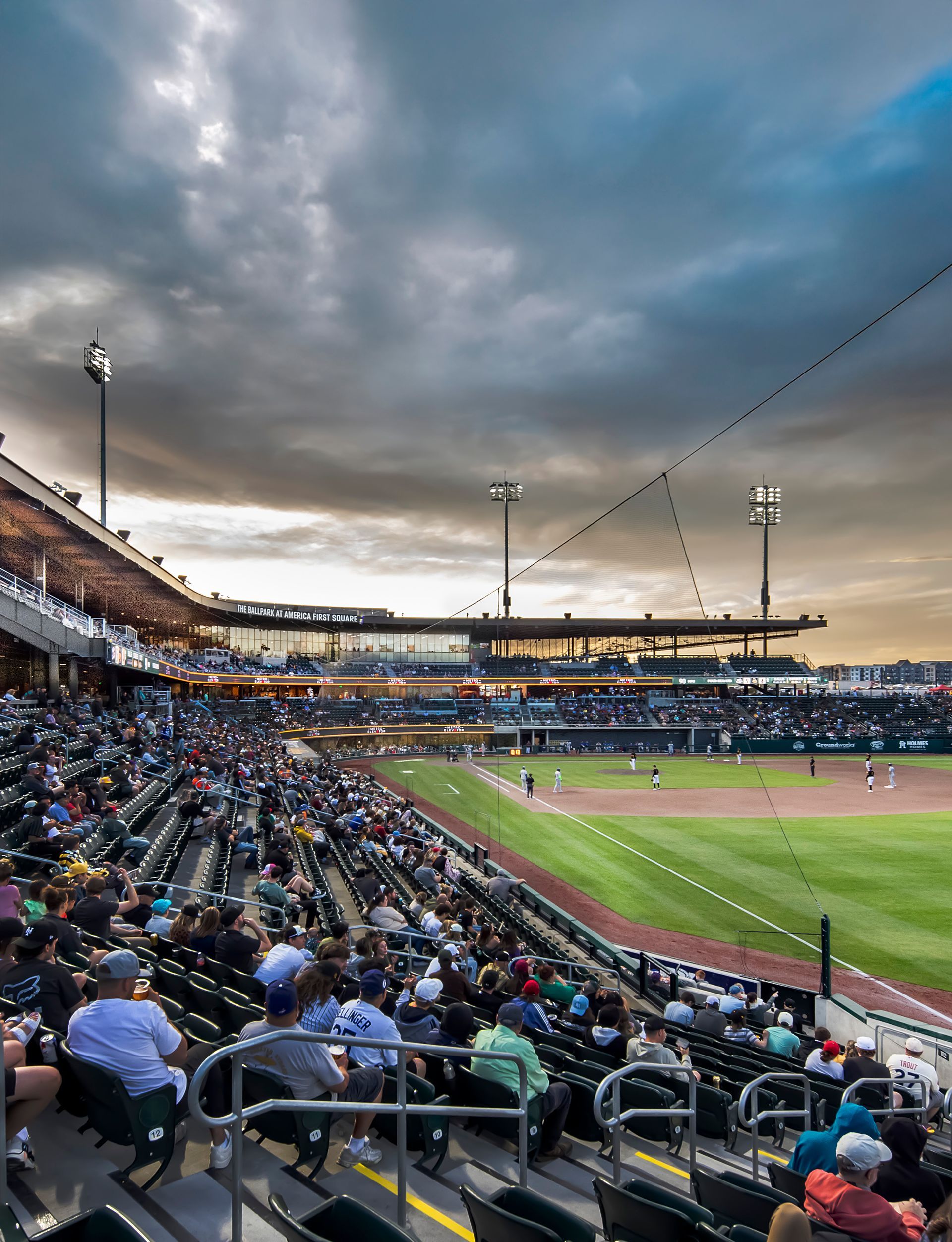
The first season is in the books for the Salt Lake Bees in its spectacular new home—the Ballpark at America First Square, the exciting new heart of Downtown Daybreak and certainly one of the premier Triple-A stadiums in the country. "It's a really cool stadium—the field looks so good!" gushed Eric Barton, Project Director for Salt Lake-based Okland Construction, while surveying the spacious 280,000 SF, 6,500-seat (8,000 capacity) ballpark. Barton said his team faced an extremely difficult construction schedule with the mandate the project had to be sufficiently ready for Opening Day 2025 on April 8, less than 18 months after the formal October 20, 2023, groundbreaking. Barton said Okland knew it was going to be a grind, with long hours and tight windows to get various milestones accomplished. "When we bid this to our trade partners, we had them bid it with the expectation of it being six days a week," he said. "We want not only your best guys, but you have to be adaptable to the plan. It was gangbusters from the start.” Up to 300 workers were onsite during peak construction activity, requiring meticulous coordination throughout. Okland even brought in Fred Strasser, a legendary project director who came out of retirement to shepherd the project through. "Fred is the genius behind getting this whole thing done," said Barton. The project was designed by Salt Lake-based HOK, who worked closely with the owner, Sandy-based Larry H. Miller Real Estate (LHMRE) and Miller Sports + Entertainment (MSE) to bring about a project that would add even more buzz to its wildly popular, 4,000-acre master planned Daybreak development in South Jordan, making it a true entertainment destination. The design weaves together best-in-class baseball experiences with year-round public amenities, including a recently opened Megaplex theater, a performing arts center, a large amphitheater, along with retail, restaurants, and apartments, with buildout continuing through 2027. Walking paths and open spaces create natural connections between The Ballpark and the surrounding neighborhood, making the area an iconic community asset and a true sports and entertainment district. Downtown Daybreak is slated to host more than 200 annual events—including the Bees’ 75-game regular season. Supporting this entertainment destination, the venue’s prominent location just off the Mountain View Corridor freeway makes it highly visible to passing traffic while providing easy access. The stadium is also connected to multiple transportation options, easily reached by walking, biking or light rail across the Wasatch Front, and by car from the new freeway corridor. The Ballpark site drops 20 feet from the loading dock to the plaza, managed through terraced spaces that echo the region’s mining heritage. Though the slope stays gentle at under 5%, carefully placed stairs and planters make walking comfortable while honoring the industrial past. The center field main entrance connects to light rail, while a formal plaza at home plate serves as a second entrance, primarily for VIP access. The street design follows Daybreak’s established standards for lighting and tree spacing. Bike racks at the light rail station and plaza make cycling to games convenient. Utah’s Landscape Shapes Design The Wasatch Mountains, visible from every angle of the ballpark, directly influenced the ballpark's design. Throughout the venue, carefully planned viewpoints frame these mountain vistas. The structure resembles this mountainous setting in its form, transitioning from solid brick and concrete at its base to lighter materials—metal and expansive glass—as it ascends. Working with Kansas City-based architectural metal fabricator Zahner, HOK and MSE created a distinctive facade using perforated metal panels that suggest Utah mountain peak silhouettes from Ben Lomond Peak in Weber County to Mt. Nebo, the southernmost and highest mountain in the Wasatch Range of Utah. These panels transform into a glowing display at night, serving as a lantern on The Ballpark’s ‘front porch’ and welcoming visitors. This connection to Utah’s landscape flows throughout the site. Angular planters guide visitors along pathways, while public spaces are arranged in terraces that echo the mountainside. The copper colors and stepped surfaces of the nearby Kennecott Mine inspired the ballpark’s materials and layout. Inside, the decor features warm copper, gold and honey tones, with textured materials that blend the natural landscape with the Salt Lake Bees’ team colors.
By Brad Fullmer October 1, 2025
Horrocks CEO Bryan Foote (left) shakes hands with Matt Hirst, former President/CEO of CRS Engineering & Survey. Horrocks acquired CRS a year ago in a move that has proven to be a seamless fit for more than 60 CRS employees.
By UC&D August 1, 2025
Nathan Goodrich